A couple weeks ago, I published a column about a conversation with a reader who rejected widely available, widely accepted data. Much of the feedback focused on that dynamic (and rightly so). But some readers pointed out a different, equally common problem: The way policymakers and “the political class” sometimes respond to criticism by assuming the public just “doesn’t understand.” Lived experience doesn’t override facts or data. But policy doesn’t exist in a vacuum, either. Every idea still has to pass through the reality people experience every day. This piece is about that side of the disconnect and why ignoring it comes at a cost.
Once again I say … we have the chance to do things differently!
Every year begins the same way for people in charge of local government.
The campaigning ends. The slogans fade. The signs come down. And the work of governing — the unglamorous, complicated part — takes center stage.
That transition matters. Because while elections come and go, the obligation to explain what you’re doing and why never does.
This is where a familiar mindset creeps in.
It’s not loud. It doesn’t show up in speeches. But you hear it when a policy stalls, when a public meeting turns sour, or when a proposal collapses under scrutiny.
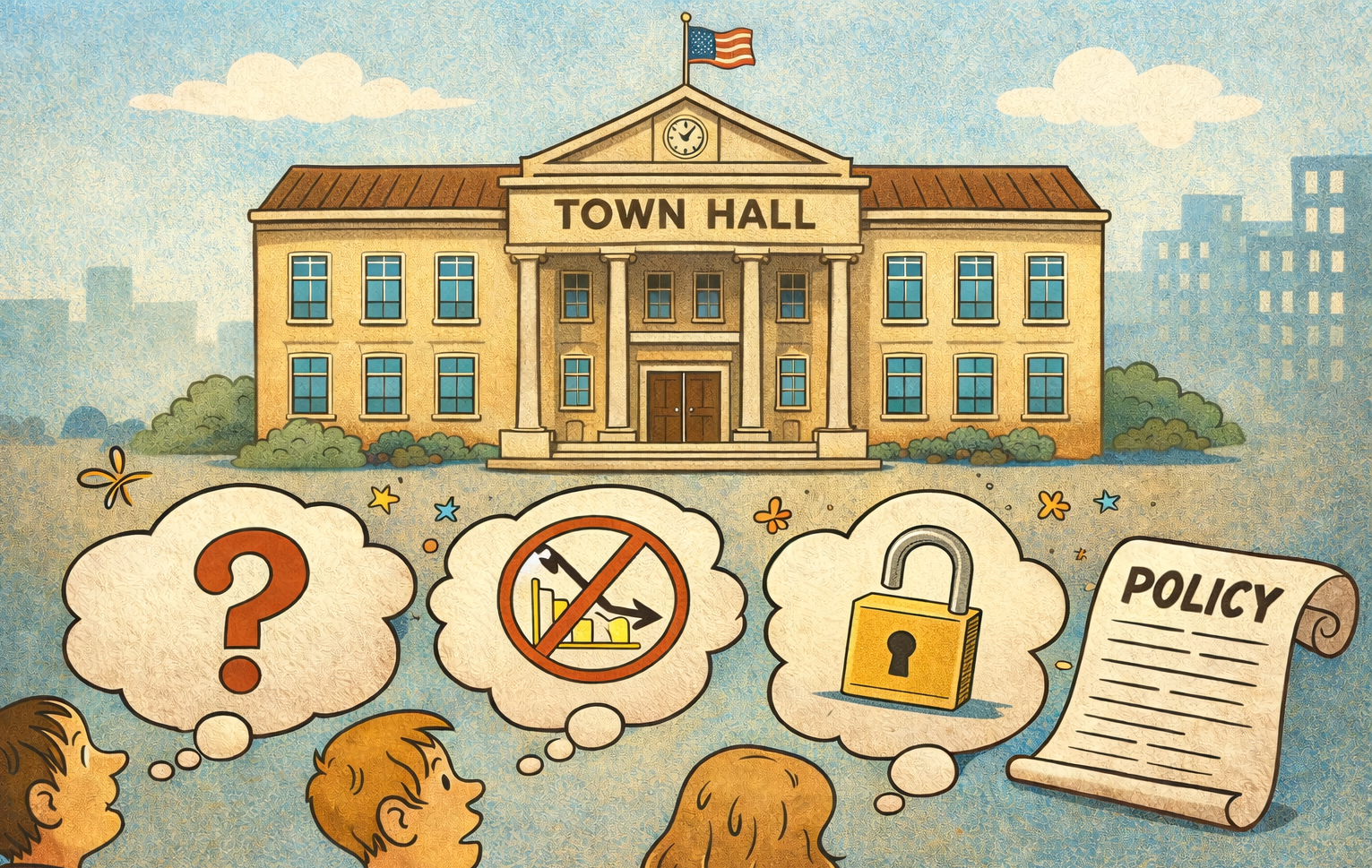
“Well, they just don’t get it.”
That assumption is the quickest way to lose trust.
The people who fall into it usually mean well. They’ve spent years on an issue. They’re often advocates, planners, or policymakers. They know the data. They’ve lived with the tradeoffs. So, when a community looks at the final version of a plan they spent years creating and says “no,” the instinct isn’t to revisit the idea.
It’s to blame the audience.
They’re uninformed. They’re emotional. They don’t understand the details. They don’t know what we know.
Here’s the problem: Most people are actually very good at assessing their own reality.
They don’t need a planning degree to know the bus doesn’t come when they need it. They don’t need to read a budget document to feel the strain of rising property taxes paired with thinning services or aging infrastructure. When something doesn’t line up with their daily experience, they notice.
And when a plan doesn’t make sense to them, the simplest explanation is often the correct one.
It doesn’t make sense.
Too often, policy is proposed as if it exists in an alternate reality. One where past decisions didn’t shape current conditions. One where constraints are theoretical and tradeoffs are optional.
Leaders blame “bureaucracy,” “process,” or “outside forces” while advancing plans that pretend those forces don’t exist. When the public pushes back — or when the proposal proves unworkable — the response becomes frustration with the public, not reflection on the policy.
It’s a convenient story: If people understood it better, they’d support it.
Sometimes that’s true. Most of the time though, it’s just an excuse.
We see this across nearly every policy area — housing, transportation, education, climate, public safety. A proposal rolls out. Opposition builds. And suddenly the conversation shifts away from substance and toward “messaging” or “education.”
Those words usually mean the same thing: If we explained it better, you’d agree with us.
But explaining isn’t the same as listening.
There’s a fine line between clarifying and condescension, and policy debates cross it constantly. A good idea shouldn’t require jargon, consultants, or a 40-page slide deck just to survive first contact with the public.
The more grounded a proposal is the less explaining it needs. And that means it more closely reflects how people actually live.
This isn’t about “dumbing things down.” It’s about respect.
People are capable of evaluating tradeoffs. They compare what they’re being told to what they experience every day. When the two don’t match, the burden isn’t on the public to squint harder.
It’s on leaders to reconcile the mismatch.
When disagreement is treated as a knowledge gap, trust erodes quickly. Once people feel talked down to, they stop listening altogether. And at that point, it doesn’t matter how clever or well-intentioned the idea was.
Policy isn’t about who sounds smartest in the room.
It’s about who earns trust.
Trust comes from listening, adjusting, and designing plans that can hold up in the real world. Not just on paper. Not just in theory. And most definitely not just among professionals.
If the coming year is going to produce better outcomes, this is the shift that has to happen.
Stop blaming the public for rejecting ideas that don’t fit. Stop writing policy for imaginary conditions and imaginary communities. Start designing solutions that respect the reality people live in.
That’s the difference between ideas that sound good and ideas that last.
And right now, we need a lot more of the latter.
Thanks for reading In Focus! Share it with a friend or drop your email address in the box below to get future updates if this was shared with you! I publish new columns every Sunday right here!