
Communities, like any living entity, have to do more than just survive—they have to engage, invest, and grow. If they don’t, they risk slipping into extinction. And for anyone who’s lived through the dissolution of a village or the shuttering of a local school, the reality is clear: Losing a community’s identity is more than just a bureaucratic process; it’s a loss of voice, representation, and shared purpose.
We’re seeing this struggle play out in real time in places like Odessa, New York. With no one willing to step up and run for office, the village government is on the brink of dissolving. When local governance fades, so does the unique identity that makes a village more than just a dot on a map. The road maintenance, the public safety decisions, the sense of local control—all absorbed by larger governments, where the specific needs of smaller communities get lost in the shuffle.
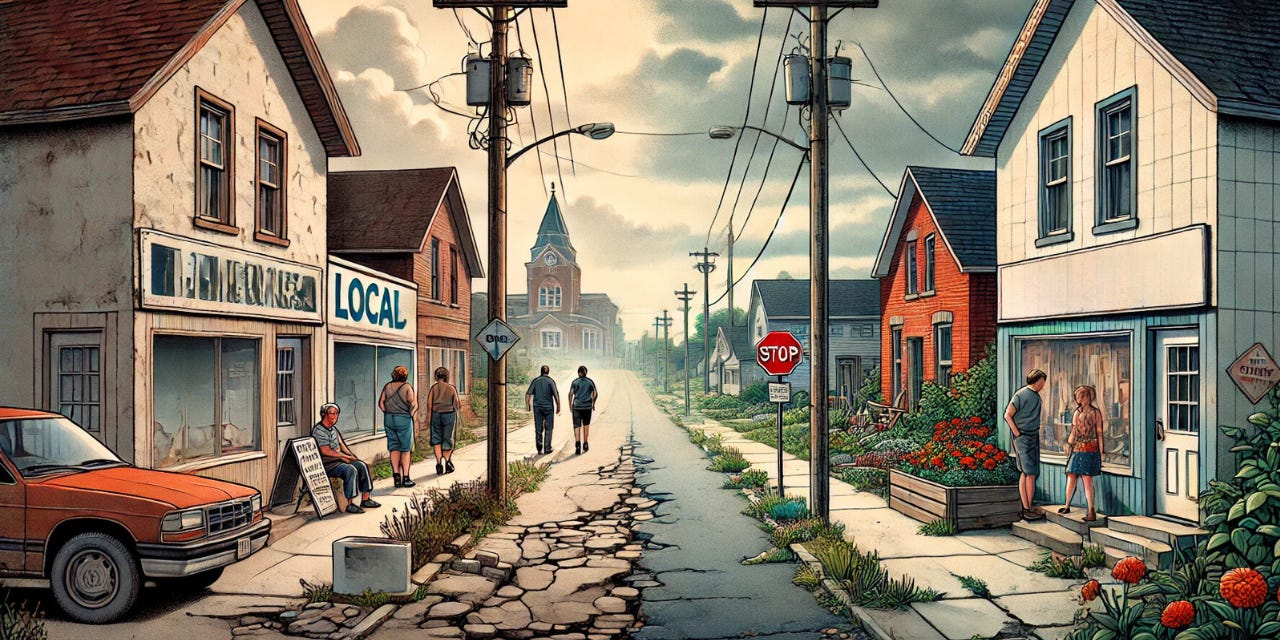
In rural areas, where the voice of the people is already faint in broader governmental decision-making, this loss of local representation is particularly devastating. Rural communities cannot afford to sit back and let things happen to them; they need to step up and actively shape their futures.
The risk of inertia is real.
We’re witnessing the consequences of inaction in schools, too. When facilities are left to age and decay, they quickly become unfit for modern educational demands—especially those on the horizon in New York State’s eyes.
Voters in the Watkins Glen School District recently rejected a $35.8 million capital improvement plan—one that would have addressed critical infrastructure, safety, and learning environment needs. The rejection reflects a community wary of costs but also a system barreling toward obsolescence. If schools aren’t modernized to meet state standards and student needs, they become prime candidates for closure, mergers, or repurposing. The outcome? The heart of the community—a local school—disappears and with it, a key piece of communal identity.
Communities that refuse to engage and invest in their future, whether through local governance or education, are essentially voting to become obsolete. It’s not just about pride; it’s about survival.
The hard truth about dissolution.
Dissolving a village like Odessa is more than just a technical process—it signals a community that has disengaged to the point of losing the will to govern itself. When no one steps up to lead, the village sacrifices not only its council but its ability to shape its own future.
As Matt Horn, Director of Municipal Services for MRB Group, noted during Wolcott’s failed dissolution attempt, the process is fraught with misinformation and misunderstanding. Many residents lack a clear grasp of what dissolution means for essential services like policing, road maintenance, and waste management.
As for the process itself, a key challenge is the disconnect between village and town governments. Horn emphasized the risk of losing local identity—villages offer tailored services and community pride that can fade when absorbed by a broader town structure.
Ultimately, successful dissolution demands clear communication, detailed planning, and collaboration between village and town officials—elements that are clearly missing here since a large swath of the population is sitting it out.
Schools are the canary in the coal mine.
The challenges facing local schools are a bellwether for broader community health. When schools are underfunded, outdated, or rejected by the very communities they serve, it’s a red flag. In Watkins Glen, the rejection of a significant improvement plan might seem like a win for fiscal caution, but it carries a hidden cost. Schools that don’t adapt will eventually be deemed unsustainable. They’ll be merged, closed, or transformed into something else entirely. And once a community loses its school, it loses a central hub of activity, identity, and pipeline to the future.
Imagine the ripple effect: Fewer families want to move into a town without a local school. Businesses that depend on a stable population begin to struggle. The tax base erodes. The community, already on fragile ground, starts to crumble.
Engagement is survival.
So, what’s the solution? Engagement. It sounds simple, but in practice, it requires a shift in mindset. Communities need to see participation not as a burden, but as a necessity. Whether it’s running for local office, attending public meetings, or voting on school improvements, these actions are the lifeblood of a thriving community.
Think about what happens when residents choose to disengage. When no one runs for office, governance dissolves. When no one supports school improvements, education falters. Disengagement is a self-fulfilling prophecy: the less you participate, the worse things get, reinforcing the idea that participation doesn’t matter. But the opposite is also true. When people step up, even in small ways, communities can thrive.
What’s the path forward?
Communities need to ask themselves hard questions. Why do we exist? What makes us unique? And how do we plan to ensure our relevance in the next decade, or even the next year? These aren’t rhetorical questions—they’re urgent calls to action.
In Odessa, the plea for local candidates is a stark reminder that engagement is the price of survival. In Watkins Glen, the rejection of the school improvement plan is a warning that progress can’t happen without community buy-in. If residents don’t step up, the decision will be made for them—by forces that care little for local nuance or history.
The uncomfortable truth is this: Communities that refuse to engage are opting for dissolution. They’re choosing to let their identity slip away. The only way forward is to participate—to invest in governance, in schools, and in each other. Because communities that do more than just exist are the ones that survive.
In case you missed it…
Last week I wrote about friend and Pulitzer nominated investigative reporter Peter Mantius ending his blog covering important regional environmental issues. If you have a moment—give it a read—because the impact Peter had on the community will not be soon forgotten.
Say Hello
Have something to say? Comments are turned on, and I’d love for you to leave one if you feel so inclined. If you’d rather send an email—whether it’s a thought on a topic discussed in the newsletter or just an idea that you’d like explored a little more—that works too! Tap the button below and it’ll launch an email that I’ll certainly see within 24 hours.