Last week I said school leaders need to say the quiet part out loud when talking about the future of their districts. Turns out they’ve been saying it to each other. Just not to the general public, at least not in the same words.
That’s a problem.
If you didn’t read it — wouldn’t blame you if you didn’t — the hook was this: Wayne-Finger Lakes BOCES announced that 22 districts would be studying the regionalization of K-12 education. Enrollment has been falling — and at first pass — the thing that seemed most-unusual was that districts keep spending on capital improvement plans like nothing’s going to change in the next few years.
I kept coming back to this question: How can we decide what to put into a building if we aren’t willing to talk about whether we’ll still be using it the same way in five years?
Then I went down the rabbit hole. I wanted to find the RFP for the regionalization study that Wayne-Finger Lakes BOCES is having the University of Rochester’s Warner School perform. I didn’t care about the cost, but I wanted ti know the scope of the effort. The press release was vague enough that I wondered: What will they study, exactly?
I didn’t find an RFP. What I found instead was a slide deck presented to the Gananda school board on Oct. 21. It’s attached at the bottom of this column.
It started with six Wayne County superintendents trying to figure out what they could do together as enrollment declined and finances got tighter.
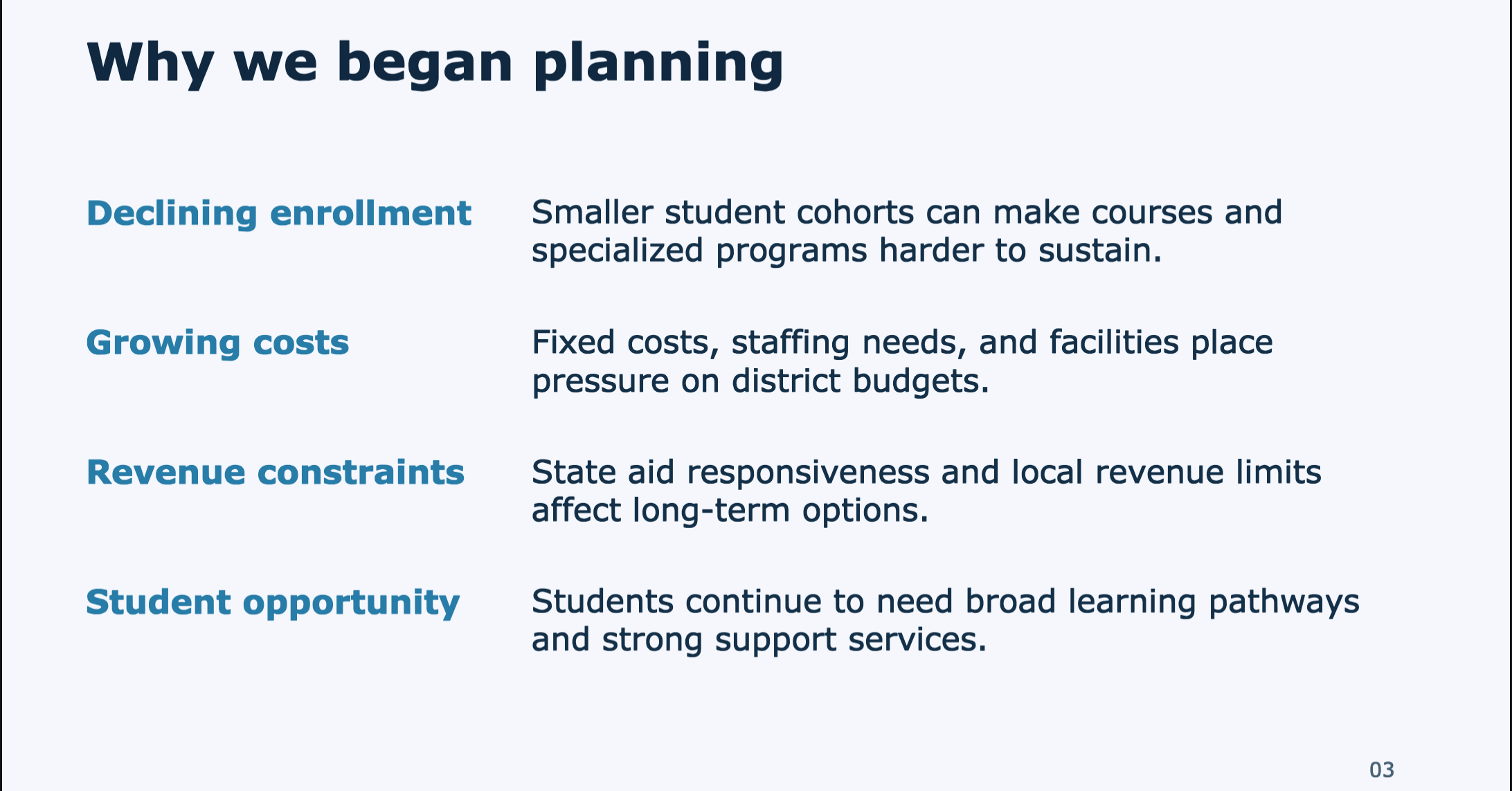
Eventually that effort expanded into the 22 district effort we heard about a couple weeks ago with BOCES leading the way.
The slide deck laid out at least four scenarios to consider for each participating district. Some dealt with sharing programs or services — predictable — but under ‘System Redesign’ it listed “regional governance, mergers, or annexations where appropriate.”
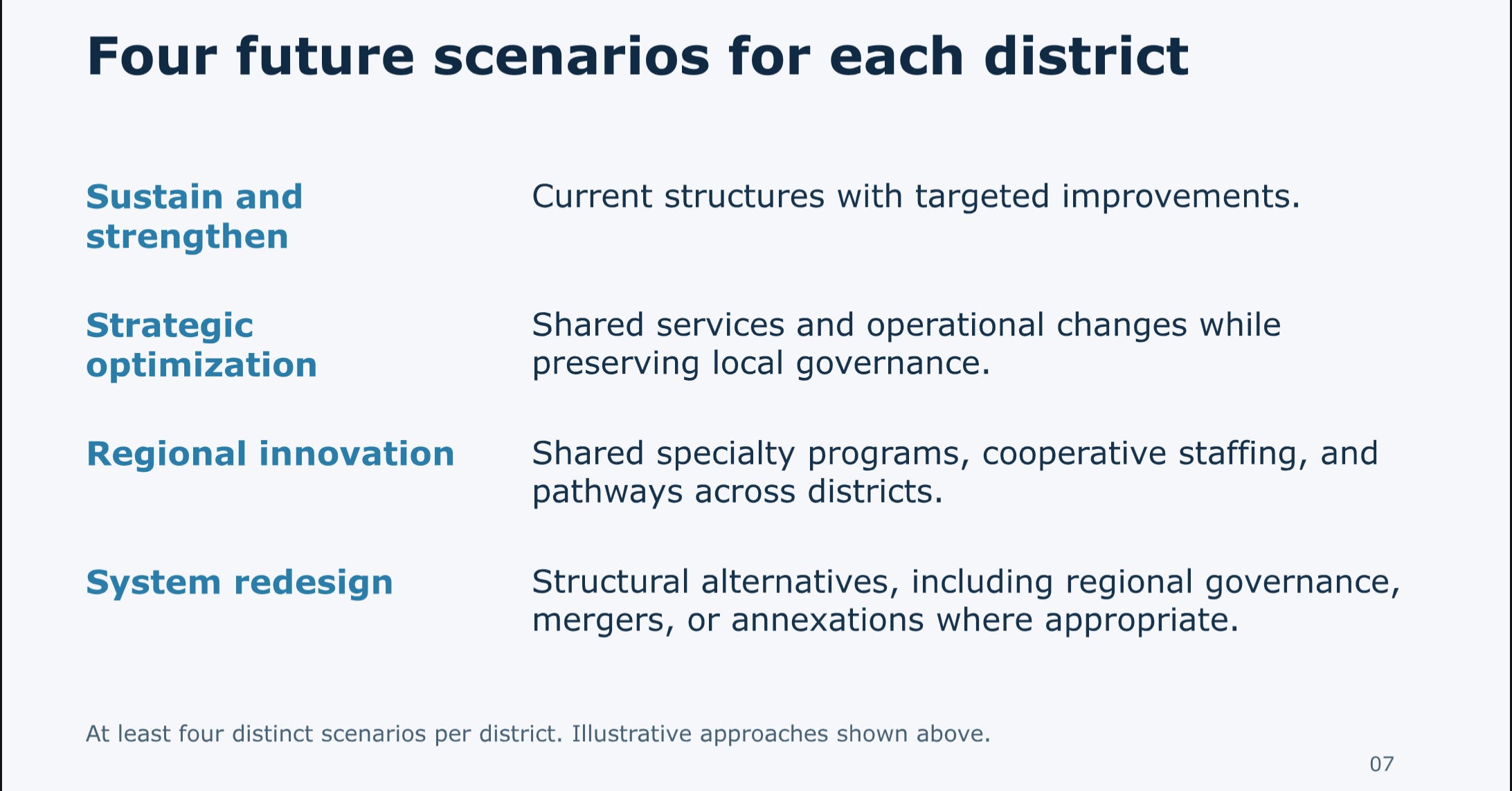
Annexation? There’s a word I wasn’t expecting. I figured mergers would be the most-intense language in the presentation. Yet here I am looking at a word that feels quite different.
So, after asking myself “What the hell does that mean?” I kept digging..
I’d been thinking about this through the lens of a traditional merger: Two districts say, “Hey, let’s study this and put it before voters.” Annexation is a completely different animal. You’re not necessarily creating a new district. One district absorbs the other. And in some cases, voters can be involved, but they don’t automatically get a ballot.
In my view, that’s significant. Because if mergers and annexations are at outcome the same thing — then why put both on the table to study?
So, I set out to figure out when the last time ‘annexation’ took place. And it turns out — it’s happening right now.
On July 1, 2027, Wynantskill will become part of Troy’s school district. The plan keeps Wynantskill’s school open, but the district itself will cease to exist. Wynantskill residents voted 709–507 in favor. Troy’s school board accepted it, and state Education Commissioner Betty Rosa signed the order. The feasibility study projected about $241 million in state operating incentive aid. That number is specific to those two districts, but it gives you an idea of why this is worth studying.
Wynantskill voters got a say because Troy is a city school district and that process required a vote in the district being absorbed.
However, annexations into an existing central school districts work differently.
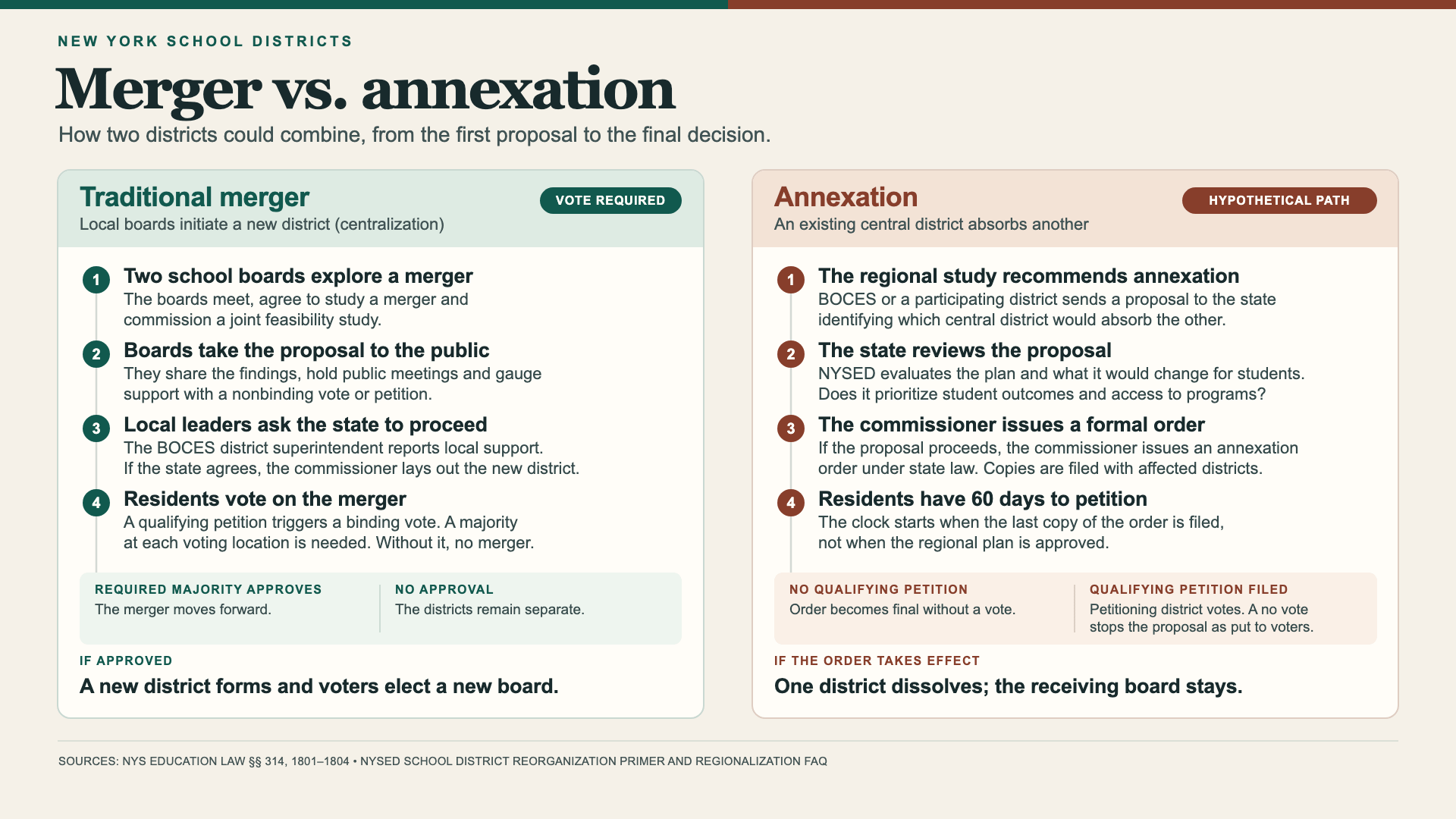
The state education commissioner can issue an order, and if enough residents don’t petition for a vote within 60 days, the order can become final without a ballot. The state says it expects clear evidence of public support before issuing an order. But that's not the same as a vote. And if I were a parent or taxpayer in one of these districts — I’d want somebody to explain that to me before the 60 day clock started.
Rosa has actually been talking about this stuff for years. In her 2023 budget testimony, she described districts that were having a hard time offering enough courses or finding teachers in certain subjects. She talked about regional high schools replacing or combining with existing ones. On mergers, she was pretty direct:
“Streamlining and updating the reorganization aid programs and statutory processes might encourage more mergers at the local level.”
In her testimony that year, Rosa also talked about districts keeping their elementary schools and contracting with another district or BOCES to deliver middle or high school programs. Pause right there. Think about that sentence for a second.
I’m not saying there’s any evidence of a state-led conspiracy to shutter shrinking school districts. Rosa made it clear districts could opt out of the state’s own regional planning initiative. That said, I think there’s enough here to assume that if school boards and administrators sign-off on a regionalization study performed by the University of Rochester — that Rosa and the state education department would green light almost anything inside it.
No matter what that physically looks like.
In my community work, I’ve spent a lot of time with people trying to help them communicate in a way the people they represent actually understand. The gap between how government talks and how most people talk might as well be as wide as the Atlantic Ocean. That’s my standard frustration with government communications. This goes way beyond that. The BOCES announcement didn’t just use language people would almost certainly ready over. It left out really important details about what the university would be looking at. “Innovative new structures” could mean a lot of different things.
Mergers and annexation are much more direct.
But I keep looking at what’s publicly available and asking myself: Did any district tell the families they represent what’s really being studied?
The Gananda slides mention community engagement. They don’t say when families will be brought in or what they’ll still have a chance to change.
And let’s be clear, if we’re to assume that most school boards within the 22 district conglomerate received this kind of presentation, we’re 2-3 months past that day. The agreement has been signed. The study is, if not already, underway soon.
And yes, it is just a study.
Nearly two dozen districts working with BOCES and the University of Rochester on the future of their schools isn’t small beans. Maybe a regular school board meeting wasn’t the right venue for this kind of conversation. Hold a special forum about what the future of the district could look like. Tell people what’s being studied, including the options nobody particularly wants to land in headlines. Do it before the reports are due June 1, while there’s still time for something somebody says to change the work that’s happening.
You know, if public input is even part of the equation.
I’m not anti-merger. I think a lot of school districts in the Finger Lakes will have to merge in the coming years. The data makes that clear. And I think it’s great that experts from the University of Rochester have been tasked with coming up with solutions. But, like I wrote last week — that doesn’t give district leaders or school boards a pass from having to say the quiet part out loud.
Gananda Boe Regional Future Of Education Blueprint 2026 10 21 1533KB ∙ PDF fileDownloadDownload