
Another day, another dreadful report about the 'state' of housing in the U.S.
I wish there were good news to share here, as I continue writing about something that's clearly become the issue of our time: Housing.
Alas, the news is grim. This time, coming from a new Gallup poll, which found that less than one-third of non-homeowners expect to buy a home in the next five years.
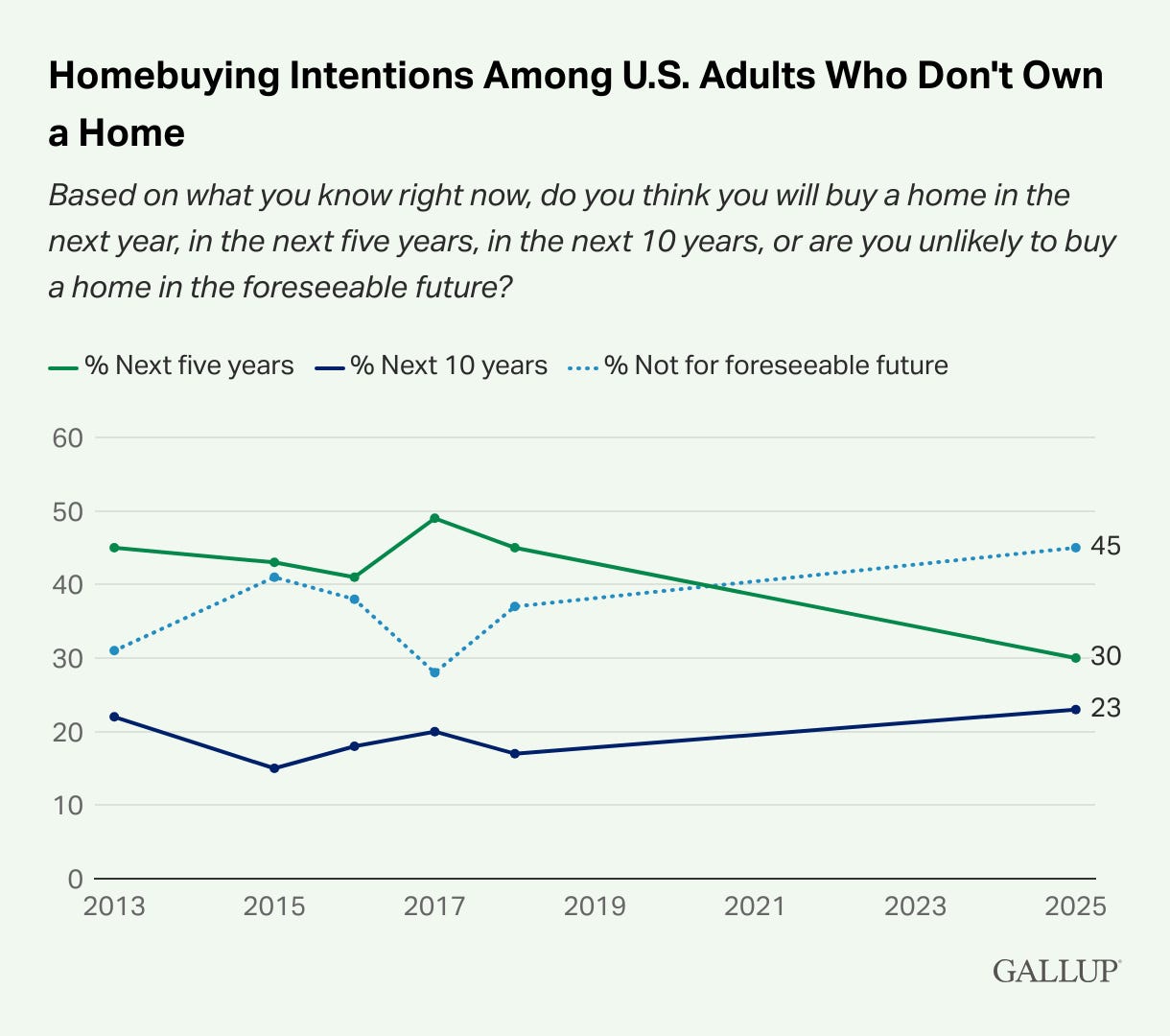
Think about that for a second. Only 30% of non-homeowners believe they'll buy within the next five years, down from 41% just a few years ago. That’s not a slight dip—that’s a warning sign flashing red for anyone paying attention.
And if that wasn't enough, another report—this one from the National Association of Realtors—found that first-time homebuyers now make up only 24% of the market, a historic low. Just last year it was 32%. When nearly three-quarters of the market is made up of repeat buyers, it's clear the door to homeownership is closing for an entire generation.
Part of the story is price. Part of it is policy failure. But another glaring part is how fundamentally different the market looks today compared to even a decade ago. The typical first-time buyer is now 38 years old, up from 35 last year, while repeat buyers are averaging 61 years old. We’ve officially crossed into "late-middle-age" as the median buyer profile.
The picture gets even more complicated—and more sobering—when you look at how people are affording homes in 2024. Seventeen percent of buyers purchased multigenerational homes, the highest share ever recorded. In plain English: Families are consolidating because the math no longer works to live separately. Whether it's caring for aging parents, adult kids returning home, or simple cost-saving, people are doing whatever it takes to keep a roof over everyone's head.
And for first-time buyers, it's getting harder and harder to go it alone. A quarter now rely on loans or gifts from family and friends, 21% tap financial assets, and a record-high 7% use inheritances to make homeownership possible. The traditional image of the scrappy young buyer saving diligently to put 20% down? That's becoming a myth for all but the wealthiest.
Speaking of down payments: They're surging too. The median down payment has climbed to 18% overall—and for first-time buyers, it’s 9%, the highest it's been since 1997. Meanwhile, repeat buyers are putting down 23%, the highest since 2003. You either have generational wealth behind you—or you face an increasingly impossible ladder to climb.
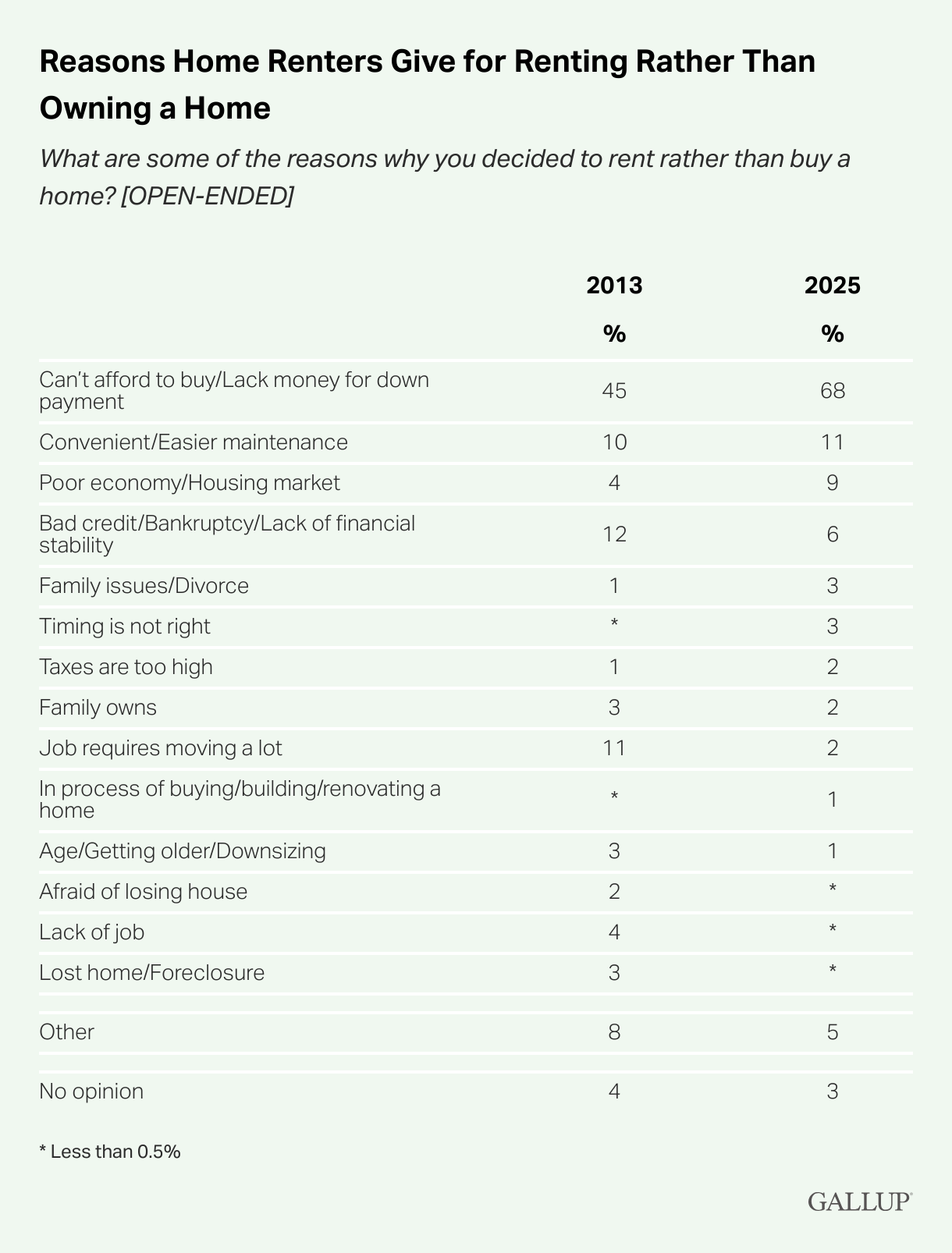
No surprise, then, that two-thirds of renters (68%) cite affordability—being priced out or lacking a down payment—as the main reason they rent, a sharp increase from 45% just over a decade ago. Renting isn’t a choice anymore; it's a necessity. In fact, only 11% of renters say it's more convenient, and just 1% cite downsizing as a reason. This isn’t about preference. It’s about survival.
Layered on top of all that is the emotional temperature of the market. A massive 72% of Americans believe it's a bad time to buy a house, continuing a steep pessimistic trend that started in 2022. For decades, homeownership was the bedrock of the American Dream—the clearest path to building wealth and stability. Now, more Americans believe the system is rigged against them than at any point in modern history.
And even if you can break through? Good luck. Median household incomes for buyers have reached all-time highs: $97,000 for first-time buyers, $114,300 for repeat buyers, and $108,800 overall. If you aren’t pulling six figures—or don’t have family money—you’re not just locked out; you’re stuck watching the market pass you by.
Housing isn’t just a “market issue” anymore. It’s a systemic one. It's reshaping family life, career paths, economic mobility, and the very fabric of American society.
If leaders aren’t willing to treat it like the generational crisis it is, they should brace themselves for the generational backlash that's coming.
In case you missed it
Last month I wrote about supply-and-demand, as well as the book Abundance, which I highly recommend reading for anyone who wants to see solutions to the housing crisis in the U.S. You can check out the full column by tapping the button below.