Earlier this week, my phone rang, and the caller ID read “Peter Mantius.” It was midday, and the moment I answered, I knew this wasn’t an ordinary call. Peter told me then—what he shared with the rest of the world two days later—that he was shutting down The Water Front Online, the publication that had become the cornerstone of the most important and influential environmental journalism in the Finger Lakes.
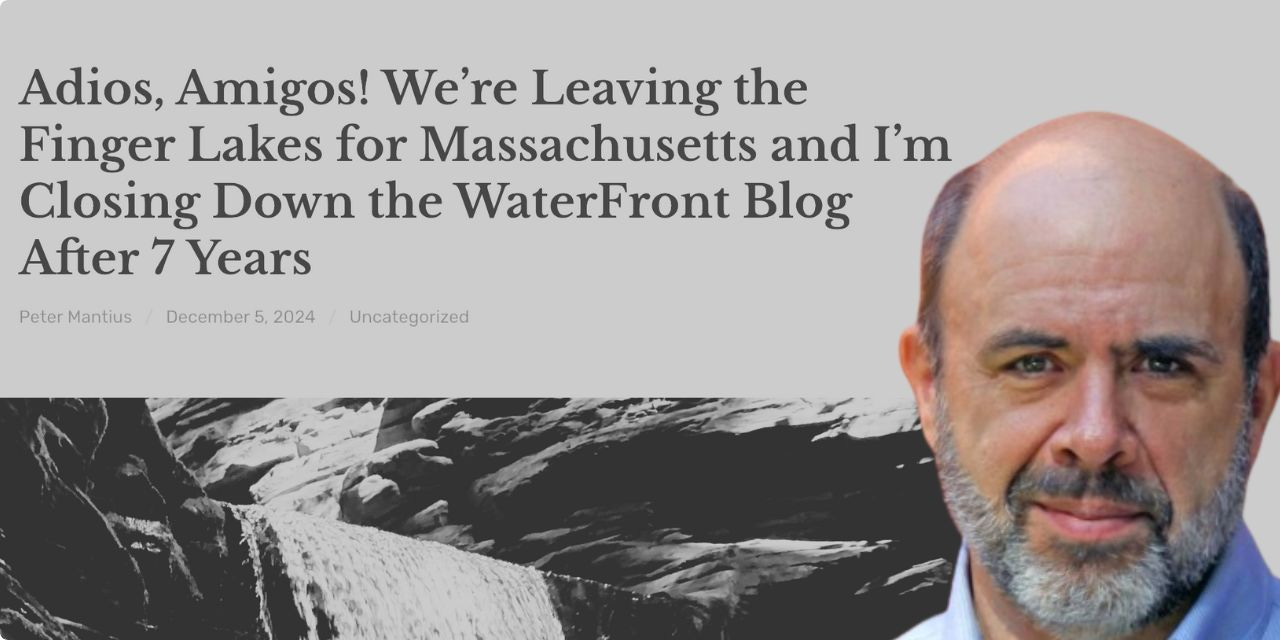
The response to Peter’s announcement was overwhelming: The community expressed deep gratitude for the in-depth and essential work he had done over seven years. He accomplished it all without ever collecting—or accepting—a dollar for the countless hours spent researching, interviewing, and chasing lead after lead, often facing disdain from the very subjects of his reporting.
Yet, that’s the nature of investigative journalism, and Peter handled it with remarkable focus and professionalism. He remained willing to engage with those who felt his reporting was unfair or overstepped, always striving to maintain the integrity of his work.
We first crossed paths when I was a beat reporter covering town and county boards across the region for FingerLakes1.com. Our work naturally overlapped. While Peter tackled environmental hot spots and issues—whether it was HABs, fracking, bitcoin mining, Cargill’s massive salt mine under Cayuga Lake, or the region’s numerous landfills—I focused on the day-to-day politics. It didn’t take long for us to see the potential in collaborating. This wasn’t just about working together on individual stories or trading sources; it was about bringing his exceptional work to a much larger audience. Shortly after, Peter’s reporting began appearing on FingerLakes1.com, and it quickly became a hit with readers.
They appreciated his work because it harkened back to the golden era of journalism. He was a product of the investigative journalists who paved the way before him, and it showed in every piece he produced—rich in depth, detail, layers, and, most importantly, authority. Unlike beat reporting, investigative journalism demands time, dedication, meticulous attention to detail, and unwavering focus—qualities that many modern news consumers, particularly those under 60, may not fully recognize.
And let’s not lose sight of the fact that Peter’s career was marked by numerous accolades, including three Pulitzer Prize nominations during his 17 years at The Atlanta Journal-Constitution. He earned first-place awards from the Society of Professional Journalists, the Associated Press, UPI, and others because of his exceptional reporting on finance, courts, and politics. One of those Pulitzer nominatinos also led to the publication of Shell Game, a critically acclaimed book praised by The New York Times as “smart, tenacious, and uncompromised.”
For those of you keeping score at home—the Finger Lakes region hasn’t seen a journalist like him in the last couple decades. Especially given the erosion of journalism, ever-changing trends in news consumption, and rise of social media as a replacement to legacy media. But Peter was here! Living in Watkins Glen, reporting on some of the most-important issues the region faces. That is, to say the least, a very unique gift!
In his announcement to the world that The Water Front would be shutting down—he noted the timing. “Events in the last couple of months — both personal and political — led us to speed up our departure plans,” Peter wrote on Thursday. I knew at some point he would hang it up. And I think most people who read his work knew the day would come eventually. But, it was still a surprise—to get that call—and now see the day in the future where in-depth environmental reporting ceases to exist as it has for the last half-dozen years.
“Of course, I regret having to abruptly stop blogging on the politics of the environment in the Finger Lakes,” Peter said. “I really hope someone will step up to take over the work of digging deep into thorny technical and political issues. Our beautiful region needs it, deserves it.”
But as I read those words, one sobering truth became clear: Those very reasons are why there won’t be a successor. This is a reality that people who consume and applaud work like Peter’s need to understand. He was a retired journalist with decades of expertise, the right tools, and the drive to tackle complex, layered issues that require both technical knowledge and investigative skill. He did it without a paycheck, dedicating countless hours to work that others simply don’t have the resources or time to replicate. In the current state of journalism in the Finger Lakes, this kind of work comes at a cost—one that is entirely unsustainable.
Some astute readers who have followed Peter’s work over the years might argue that it reflects the path the region is taking environmentally—unsustainable and rapidly heading into uncharted territory.
Others have, and will continue to, argue—without basis—that willpower alone is enough to produce reporting like Peter’s. Let me be clear: That notion dramatically undervalues the skill, dedication, and importance of his work. Consider his top-performing story of 2024 on FingerLakes1.com, “HABs now widespread across Finger Lakes: State rejects proposed rules to protect Owasco Lake,” published in early August. Within a month, it had been read over 56,000 times, yet it generated just $222.18 in ad revenue—an essential source for keeping publications afloat. And here’s the thing: That wasn’t even Peter’s most significant work on harmful algal blooms this year. About a month ago, he published “Toxic blooms in Finger Lakes set record in 2024: Owasco Lake called region’s ‘canary in the coal mine’ for HABs,” which captured one of the most intense ends to algae season in the region’s history and the ongoing legal battle involving Owasco Lake. That story was read over 45,000 times, but generated less than $40 in ad revenue, because of the finicky way Google’s ad system operates.
And the simple truth about advertising as a way to sustain publishing companies is this: Fewer and fewer businesses are choosing to spend their money with local news organizations. This isn’t a new trend, but it’s one that shows no signs of reversing anytime soon—certainly not in time to inspire another journalist like Peter to step up.
Like everyone else, I want to say thank you to Peter—for his remarkable work in the region, his unwavering dedication to the craft of journalism, and his professionalism. This wasn’t just evident in how he approached delicate subjects and complex stories, but also in how he treated everyone he encountered. On a personal level, I’m especially grateful for the opportunity to learn from him—his ability to present intricate, multi-layered stories in a way that resonated with readers juggling jobs, kids, and busy lives is a masterclass in journalism. His professional legacy is a reminder of what thoughtful, impactful reporting can achieve, even in an increasingly challenging landscape.
We’ll get back to our regularly scheduled newsletters later this week. I’d encourage everyone who read this far along to check out his work—whether it’s on The Water Front blog or on FingerLakes1.com. It’ll stand the test of time. That I’m confident.
Say Hello
Have something to say? Comments are turned on, and I’d love for you to leave one if you feel so inclined. If you’d rather send an email—whether it’s a thought on a topic discussed in the newsletter or just an idea that you’d like explored a little more—that works too! Tap the button below and it’ll launch an email that I’ll certainly see within 24 hours.