
Last weekend I wrote about not waiting for a crisis to make hard decisions. That piece got a lot of positive feedback. I also had another column lined up about decision-making, and whether municipalities are actually positioned to make the kinds of big, difficult decisions communities increasingly face.
If the news cycle hadn’t intervened yesterday, it would’ve published this morning. But here we are: Rochester Regional Health announced it intends to end delivery and birthing services at Newark-Wayne Community Hospital.
The news was a surprise around the region, especially within the healthcare workforce, because they know firsthand how stretched these services already are in the Finger Lakes.
Residents are finding out too. Especially older and more vulnerable populations who are already driving farther and paying more for increasingly consolidated — and often lower-quality — services. But let’s set that aside for a moment and focus exclusively on the announcement, and take it all at face value.
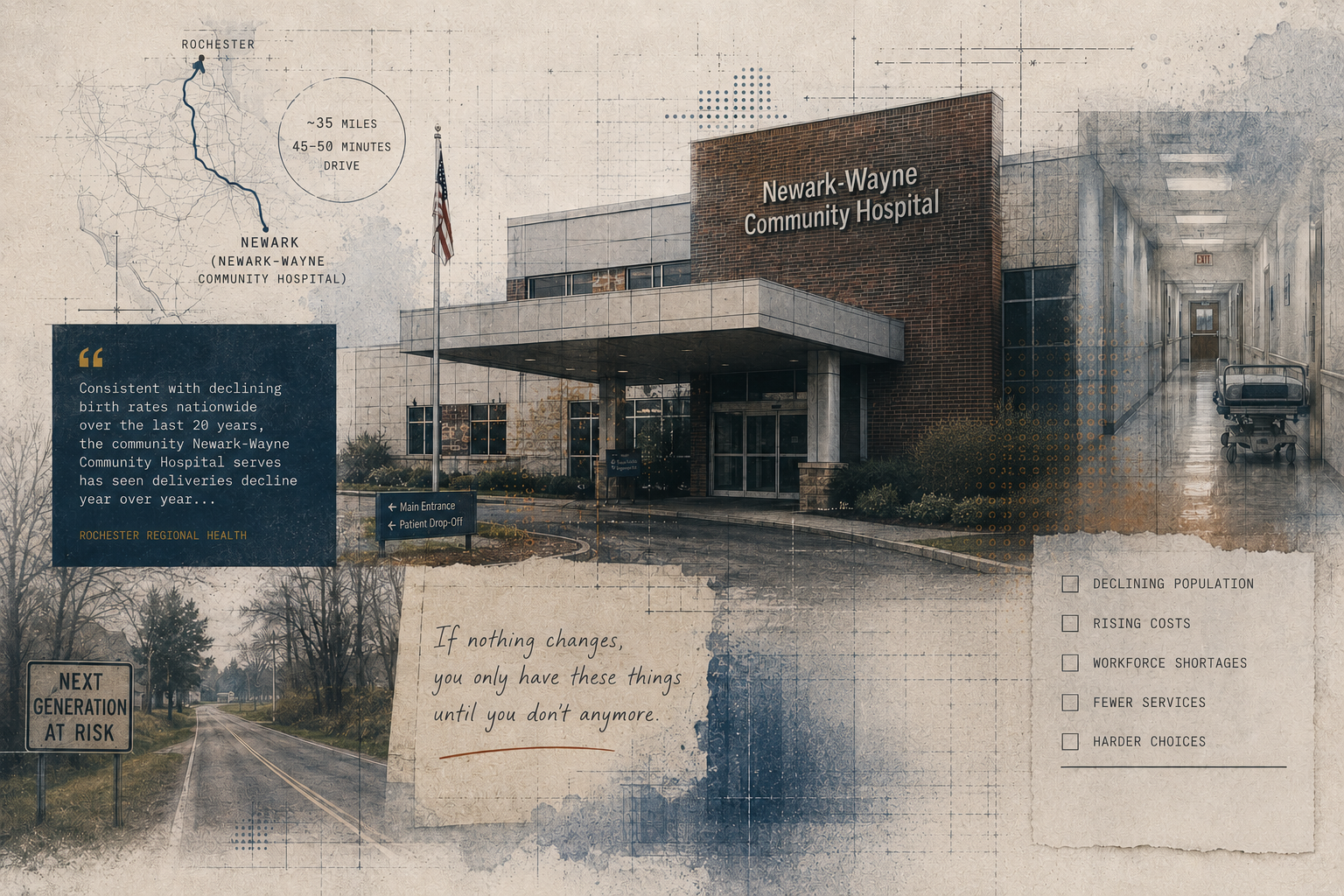
Rochester Regional said Wednesday afternoon that it had made the difficult decision to begin the state approval process to end inpatient labor and delivery, newborn nursery, and postpartum services at Newark-Wayne. The most important of these services — delivery — will be moved to Rochester General Hospital, which is around 35 miles away, or a 45-50 minute drive.
The process is already underway and pending final approval from the state Department of Health.
Publicly, the system assured residents that the hospital will remain open and fully operational even though it’s eliminating what many view as a crucial service, continuing to provide emergency care, surgical services, and other inpatient and outpatient care.
Here’s what Rochester Regional said about why:
“Consistent with declining birth rates nationwide over the last 20 years, the community Newark-Wayne Community Hospital serves has seen deliveries decline year over year, reflecting changing community needs and broader demographic trends. Combined with persistent workforce challenges, these realities have made it increasingly difficult to safely and sustainably staff a 24/7 inpatient labor and delivery unit. For Newark-Wayne OB patients who need delivery services, concentrating resources at nearby locations will enable RRH to provide a higher level of care.”
It’s expected this will all be finalized by fall.
Even though the announcement lacked specifics — it’s impossible to ignore the reference to data most have accepted as true. It’s fair to assume there were other very complicated factors that contributed to the decision, too. Factors unique to healthcare. But hospitals don’t operate in a vacuum.
Birth rates are declining. Population is declining. The cost of operating — whether you’re a municipality, a hospital, or a family trying to manage a household budget — is skyrocketing. And there’s plenty of blame to go around.
But I’m here to say this was always avoidable. There was always another path. Instead, the problem has been ignored — and in some cases amplified — by people more afraid of new faces than the grim reality many Finger Lakes communities are barreling toward.
I’ve written about Newark for years. I mentioned the village again last week in my open letter to Seneca Falls, and before that I’d written similar warnings about places like Auburn, Canandaigua, and Geneva. These are communities with strong institutions, committed residents, and far more capacity to absorb hardship than most others across the region. Yet even they are struggling through overlapping crises and destabilizing losses — including decisions like a hospital eliminating a vital service.
We can talk about these problems in a vacuum. We can blame Rochester Regional Health for mishandling its business. We can pretend these decisions aren’t connected to the monthly choices elected officials and residents have been making for the last two decades. But every community needs more people. That means more housing. That means more new faces. It means discomfort. It means communities that may not look exactly like they do today.
This is urgent. It matters. Communities need to act. Because if the trend line doesn’t change, it won’t just be delivery services that disappear. It will be broader, more essential services. And before long, living in the communities that exist just outside the handful of strong, resilient regional centers will become increasingly difficult — if not impossible.
I’ll say the part Rochester Regional couldn’t say out loud in its announcement. In fact, I’ll close with it.
Newark-Wayne Community Hospital will remain open and fully operational — as long as it can, and as long as it financially makes sense to do so. Nothing more is promised. Nothing beyond this moment is guaranteed. So don’t read this announcement and think, “It’s a shame we lost that, but at least we still have the hospital and it’s emergency room.”
Because if nothing changes you only have those things until you don’t anymore.
Thanks for reading In Focus! I write about the things that are happening around the Finger Lakes. Later this month, I’m launching a new podcast. Drop your email below to never miss a new column or new episodes of that podcast.