For months, readers of this column and newsletter have been asking for something more than a weekly essay — a place for longer conversations about the ideas, challenges, and solutions we explore here. After a lot of planning, I’m excited to finally make that happen.
In Focus is now available on YouTube, Spotify, Apple Podcasts, and will be rolling out to most other podcast platforms over the coming days. New episodes will be released weekly, right here on Substack.
The housing crisis isn’t just a housing crisis
For years, local governments have treated issues like housing, transportation, economic development, addiction, and mental health as separate policy conversations. We create separate committees, separate departments, separate funding streams, and separate political debates. Then we act surprised when none of the solutions seem to really work.
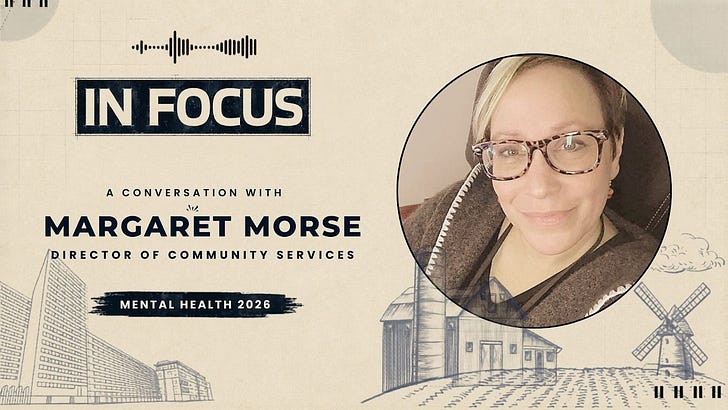
My conversation with Seneca County Community Services Director Margaret Morse reinforced something I’ve been writing about for years: People don’t experience problems in neat categories. They experience them all at once.
One of the most striking moments in our discussion came when Morse described how mental health treatment has historically lagged behind addiction treatment in recognizing the importance of community, housing, employment, and social connection. Addiction recovery programs long understood that people, places, and support systems matter just as much as therapy sessions and medication. Mental health treatment, by comparison, spent decades operating through a more clinical, medical model.
That’s changing. But slowly.
The reality Morse laid out is simple: If someone doesn’t know where they’re going to live next month, if they’re struggling to afford transportation, if they’re isolated from their community, if they don’t feel like they belong anywhere, it becomes extraordinarily difficult to make progress on anything else.
That should sound familiar because it’s the same argument advocates make about workforce shortages. It’s the same argument developers make about housing. It’s the same argument economic development officials make when they talk about population decline.
We’re all describing different symptoms of the same underlying problem.
For years, communities have chased individual solutions while ignoring how interconnected the challenges really are. Morse’s point wasn’t that mental health should become the center of every public policy conversation. It’s that mental health outcomes are often the clearest indicator of whether the rest of our systems are actually working.
And since a quarter of the people receiving services in Seneca County report feeling lonely, disconnected, and like they don’t belong, that’s not just a mental health statistic. That’s a community statistic.
Social media isn’t connecting us nearly as much as we claim
Few subjects generate more predictable arguments than social media.
Supporters point to connection. Critics point to anxiety, depression, addiction, polarization, and isolation. After talking with Morse, I’m increasingly convinced that we’re losing that argument.
She acknowledged the obvious benefits. Social media can help isolated people find support. Rural residents can access recovery groups, mental health resources, and communities that would otherwise be unavailable. For some people, those connections genuinely matter.
But the broader picture is harder to ignore.
Morse pointed to what countless studies have already found: Younger generations are reporting significantly higher rates of anxiety, depression, and poor mental health. She described a generation that has never known life without screens, algorithms, notifications, and constant connectivity.
What struck me wasn’t the discussion about technology itself. It was the contradiction.
The companies behind these platforms frequently argue they’re building community. Yet at the same time, loneliness, isolation, and lack of belonging consistently show up as some of the strongest predictors of poor mental health outcomes.
If we’re supposedly more connected than ever, why do so many people feel alone?
That question deserves far more attention than it gets.
Maybe the issue isn’t that social media fails to create connections. Maybe it’s that digital connection isn’t a complete substitute for real community. A comment section isn’t a neighborhood. A Facebook group isn’t a civic organization. An algorithm isn’t a friend.
Technology can absolutely supplement community. But somewhere along the way, we’ve started treating it as a replacement. The evidence increasingly suggests that’s a mistake.
Rural communities desperately need more belonging. If there was one takeaway local leaders should pay attention to from this conversation, it’s that mental health isn’t just about treatment capacity.
It’s about belonging and building real community.
Morse talked about survey data collected from people receiving services in Seneca County. For my money, one finding stood out above the rest. People who reported feeling lonely and disconnected also reported significantly worse mental health outcomes. Many said their mental health providers were among the only supports they had in their lives.
That should feel a little jarring. Because treatment and providers can only do so much.
A therapist can help someone develop coping skills. A psychiatrist can prescribe medication. A case manager can connect someone to resources. But none of those professionals can manufacture community.
They can’t create friendships. They can’t create neighborhood gathering places. They can’t create a sense of belonging. And in many rural communities, those opportunities are disappearing or haven’t existed for years.
Population decline, fewer civic organizations, fewer informal gathering places, transportation challenges, and economic pressures have all chipped away at the spaces where people once built relationships naturally.
The policy response to mental health often focuses on expanding treatment. More counselors. More programs. More services.
Those things matter.
But Morse made a compelling case that prevention may be even more important. She pointed to early childhood intervention, support for families, and programs that build resilience before crises emerge. She also repeatedly returned to the importance of helping people connect with one another.
That’s a lesson that extends well beyond mental health.
The strongest communities aren’t simply the ones with the most services. They’re the ones where people feel like they belong.
And if we’re serious about improving outcomes — whether we’re talking about mental health, addiction, economic development, or population growth — that’s probably where we should start.
Thanks for listening and watching. Consider subscribing for free if you want to get the latest columns and podcast episodes delivered to your inbox.