There’s a version of the housing debate that feels really easy. It’s clean. It’s simple to understand. Build less, protect more. Preserve what makes a place special. Whatever you do — don’t let growth ruin it.
But that version of the debate has completely broken down.
Because across the country — small towns, mid-sized communities, and big cities alike — we’re running into the same problem: The people who care the most about the environment are increasingly at odds with the type of housing that would actually protect it long-term.
Not in theory. In real life.
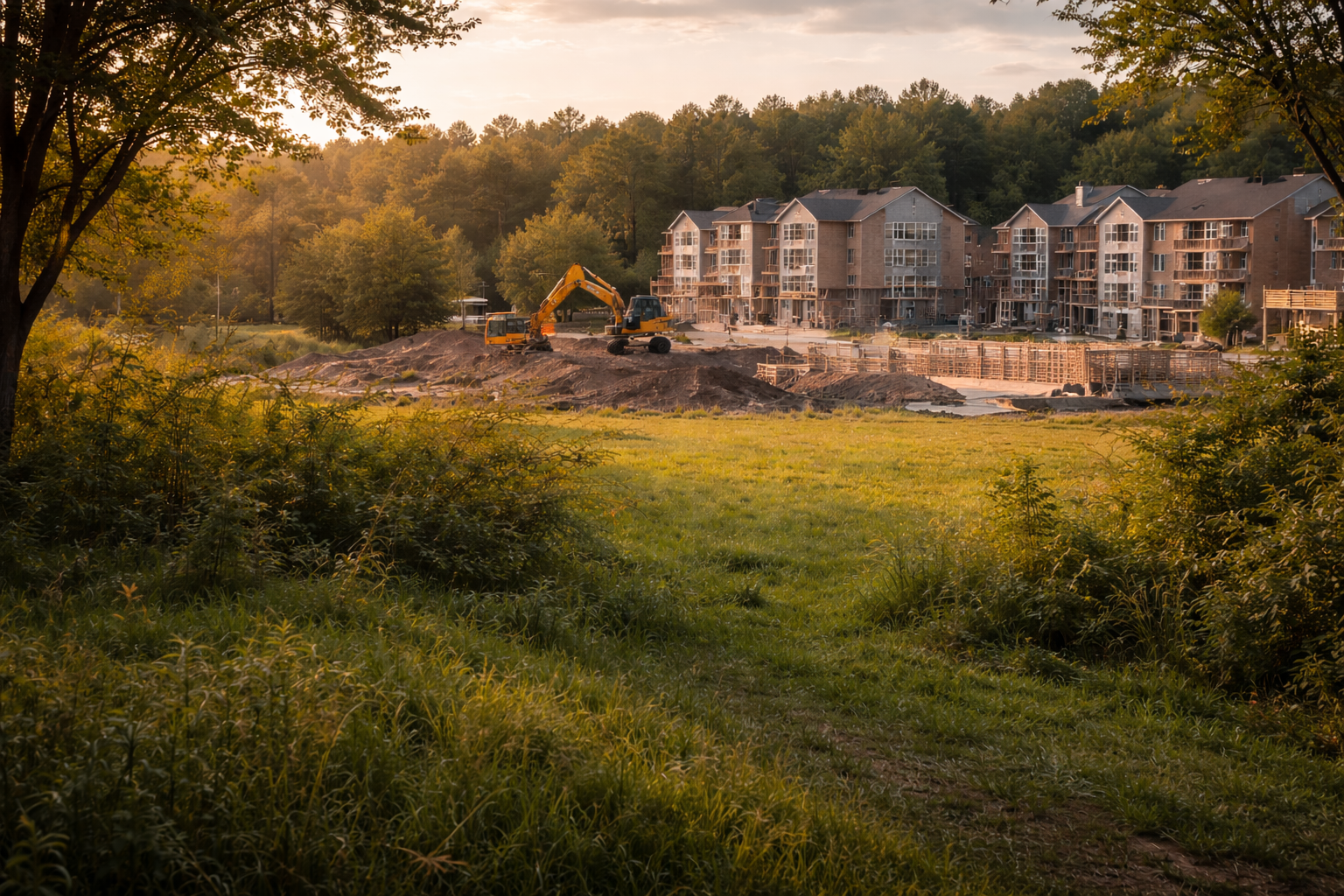
The tension shows up the same way most times. A housing project gets proposed. Maybe it’s modest — townhomes, apartments, something near a downtown or along a corridor that already has infrastructure. And almost immediately, the objections start to take shape. Too dense. Too much traffic. Not enough parking. What about the trees? What about the character of the neighborhood? What about the green space?
And to be clear, none of those concerns are fake. They’re real. There’s a genuine desire to protect.
But here’s the problem: When those arguments win — when projects get scaled back, delayed, or killed outright — the demand for housing doesn’t disappear.
It just moves outward.
It moves to the edge of town, or the next town over, or the rural land that was never meant to absorb that kind of growth. It moves into longer commutes, more car trips, more fragmented development patterns.
It’s sprawl. It moves into places where infrastructure is thinner, zoning protections are less, and the environmental impact is harder to see — but far more significant.
And over time, it changes who actually controls the housing that does exist. Some would argue we’ve already seen this happen across the Finger Lakes.
When supply stays constrained, prices go up. When prices go up, ownership consolidates. Not always, but often, into the hands of people and entities who aren’t invested the same way full-time residents are.
I’m talking about investors. Out-of-town (sometimes state!) buyers. People who don’t live with the day-to-day consequences of local decisions.
That matters more than we tend to admit.
Because environmental stewardship isn’t just about policy — it’s about proximity. It’s about who’s actually there, who’s invested, who has a reason to care about what happens to a lake, a shoreline, a stretch of farmland, or a neighborhood block.
If the people who want to live in a place can’t afford to buy into it, then over time the people making decisions about that place are less likely to have any real connection to it.
That’s not just a housing problem. That’s a long-term environmental policy risk. Because long-term, policies and decisions will start to mirror that population.
What makes this especially tricky is that the conflict isn’t ideological in the way people expect. This isn’t developers versus environmental advocates, or growth versus conservation. Or even Democrats versus Republicans.
It’s two versions of environmental thinking colliding. And it almost feels like it shouldn’t even exist.
One is focused on preserving what’s directly in front of us. The trees on a lot. The open space down the street. The way a neighborhood looks and feels right now.
The other is focused on what happens if we don’t build. The emissions that come with longer commutes. The land that gets consumed at the edges by sprawl. The slow erosion of local ownership and accountability.
Both are valid. But they don’t always point to the same answer. And increasingly, communities are choosing the first without fully reckoning with the cost of the second.
You can see how this plays out in real time. Projects that would add housing in walkable, infrastructure-ready areas get bogged down — sometimes defeated. Meanwhile, growth continues — just in less efficient, more environmentally costly ways. You don’t see the impact, so it’s easier to ignore. But it’s there.
If we’re serious about environmental outcomes — not just intentions or hitting talking points — then housing has to be part of that conversation in a more honest way.
That doesn’t mean every project should be approved. It doesn’t mean environmental concerns should be brushed aside. It does mean we need to start asking different questions though.
Not just “What does this project change right here?”
But rather, “What happens if it doesn’t happen at all?”
Because housing is infrastructure. And in my next column Sunday we’ll dive into two public and private sector solutions that could put meaningful units on the market, while addressing these environmental concerns.
Thanks for reading In Focus! Subscribe for free to receive new posts and support my work.