
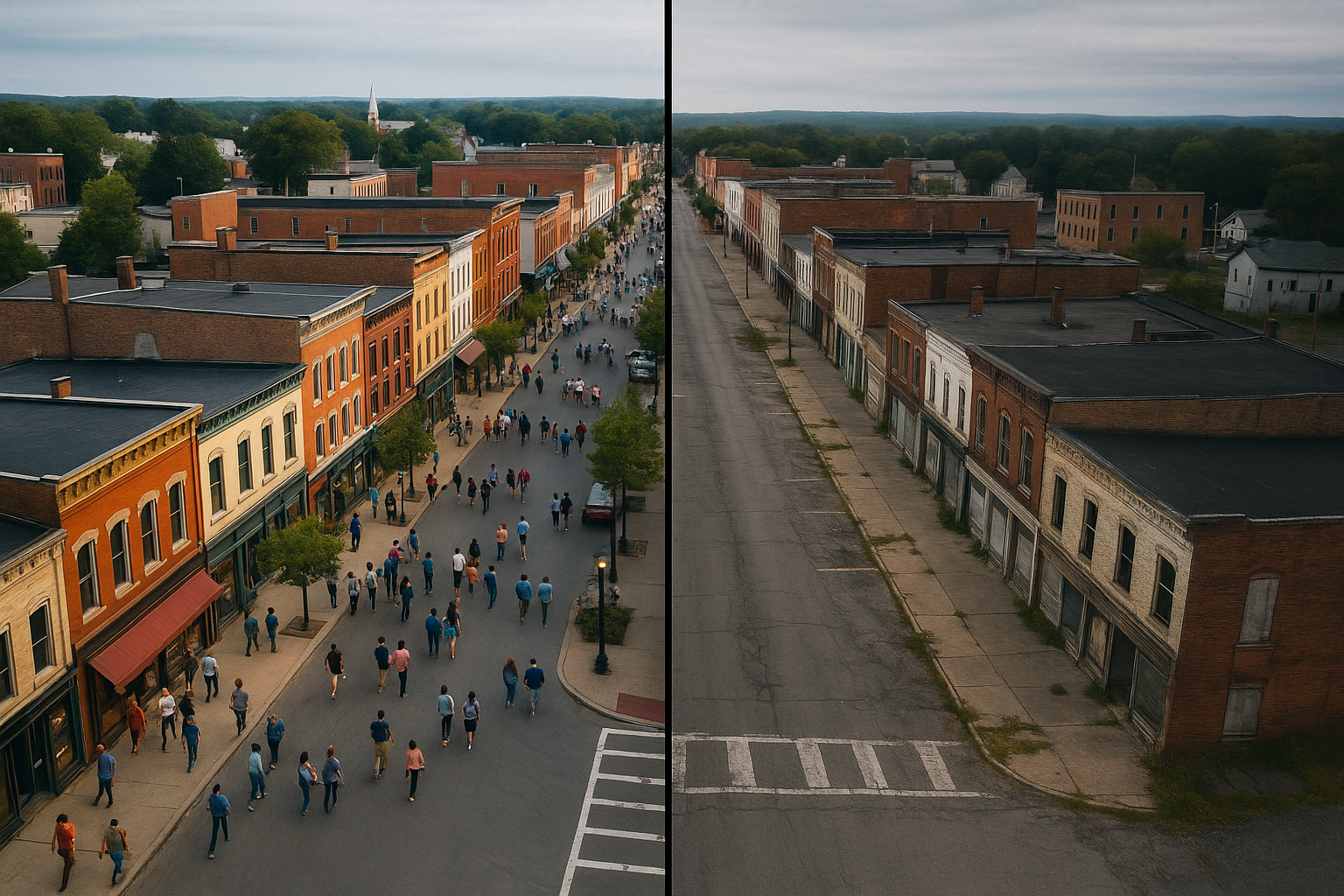
Small businesses don’t fail because New York suddenly became more expensive. They fail because the communities around them have fewer people than they used to — and because too many places fight harder against new housing than they ever did against actual economic threats.
Upstate has been shrinking for decades. New York lost more than 100,000 residents in 2023 alone, the largest numeric decline of any state. In the Finger Lakes region, most counties have fewer residents today than they did in 2010. Yet every time a café closes or a hardware store boards up, the same old excuse shows up: “If it weren’t so expensive to do business in this state, they’d still be open!”
It feels like common sense. But it’s not actually true.
Costs matter, but they didn’t suddenly spike last week. What did change is population. And nothing determines the health of a local economy more than the number of people living in it.
Look at where small businesses struggle the most. It’s almost always in communities that have spent years blocking the very things that create customers. I’m talking about housing, density, and new development. Scroll through any local Facebook group and the pattern is immediate. People railing against apartments they’ve never seen renderings for. Workforce housing dismissed before the first question is asked. New businesses greeted with some version of, “Ugh, another one of those?”
It’s the same script every time, and it’s the clearest sign of a deeper problem: People have gotten comfortable resisting change, even when their own community is the one paying the price.
This isn’t theoretical. Geneva just watched two major housing projects collapse under exactly that kind of pushback. Lakeview Health Services pulled its 74-unit mixed-use project on Genesee Street after months of hearings where a loud minority argued it would threaten “community character,” despite the city’s own planning documents identifying downtown housing as a critical need. Weeks later, Home Leasing withdrew its 60-unit proposal on Jackson Street after neighbors objected to building heights, environmental concerns that had already been addressed through remediation, and the basic idea of adding more residents to the neighborhood.
These projects weren’t magic solutions, and Geneva will survive without them. But they showed something important: Too often decline is a choice. People are fighting projects that would stabilize the communities they think they’re protecting.
And the data makes the point even clearer. The statewide housing shortage is estimated between 500,000 and 800,000 units, depending on which study you pick. Upstate rental vacancy rates are at their lowest in more than 30 years, and nearly every new development between Rochester and Syracuse pre-leases at 90 to 100% before completion.
In other words, the market is shouting what many keep ignoring. People want housing, and communities that allow it grow.
Meanwhile, places that block growth fall back on nostalgia. There’s a comforting narrative that businesses used to thrive because taxes were lower or regulations simpler. But the real difference between the so-called “good old days” and now is brutally simple. There were more residents. More families. More workers. More consumers. The Federal Reserve’s Small Business Credit Survey makes this point plainly — population inflow is one of the strongest predictors of small-business revenue stability in the Northeast. No incentive package can replace that. No grant can substitute for people.
Yet in so many towns, any proposal for new housing becomes a fight about “preserving character.” That phrase has become a shield for stagnation. Communities that refuse to grow aren’t preserving anything. They’re just delaying the consequences.
Because when the next restaurant closes, or when the next young family leaves for a town that actually approved housing, the problem won’t be taxes. It won’t be Albany. It won’t be regulations. It will be that the community spent twenty years protecting an image of itself instead of investing in a future.
Growth absolutely changes a place. New neighbors bring new expectations, new ideas, and yes, sometimes new traffic patterns. But a community that refuses to grow at all eventually becomes a place people used to live. That’s not speculation — that’s a demographic trend already playing out across Upstate. Think about all the villages and towns that once had thriving downtowns, strong school districts, and stable populations. Many of them have emptied out, merged, or lost the identity they thought would last forever.
The truth is straightforward. The “good old days” weren’t magical. They weren’t even especially unique. They were just full of people. And in the end, that’s still the one ingredient no community can live without.