This week a temporary rate hike went into effect for NYSEG and RG&E customers across Upstate New York, as the state’s Public Service Commission weighs a rate case that would see customer bills rise significantly more. Every time utility rates make it into a headline, a seemingly obvious question crops up quickly: Why don’t local communities just create their own electric utility?
It’s a fair question. After all, New York already has municipal electric systems. Communities in the Finger Lakes and beyond have operated publicly owned utilities for decades and often point to lower rates and greater local control as proof that public power is better.
But there’s a reason towns and villages across Upstate New York aren’t lining up to buy out NYSEG or RG&E.
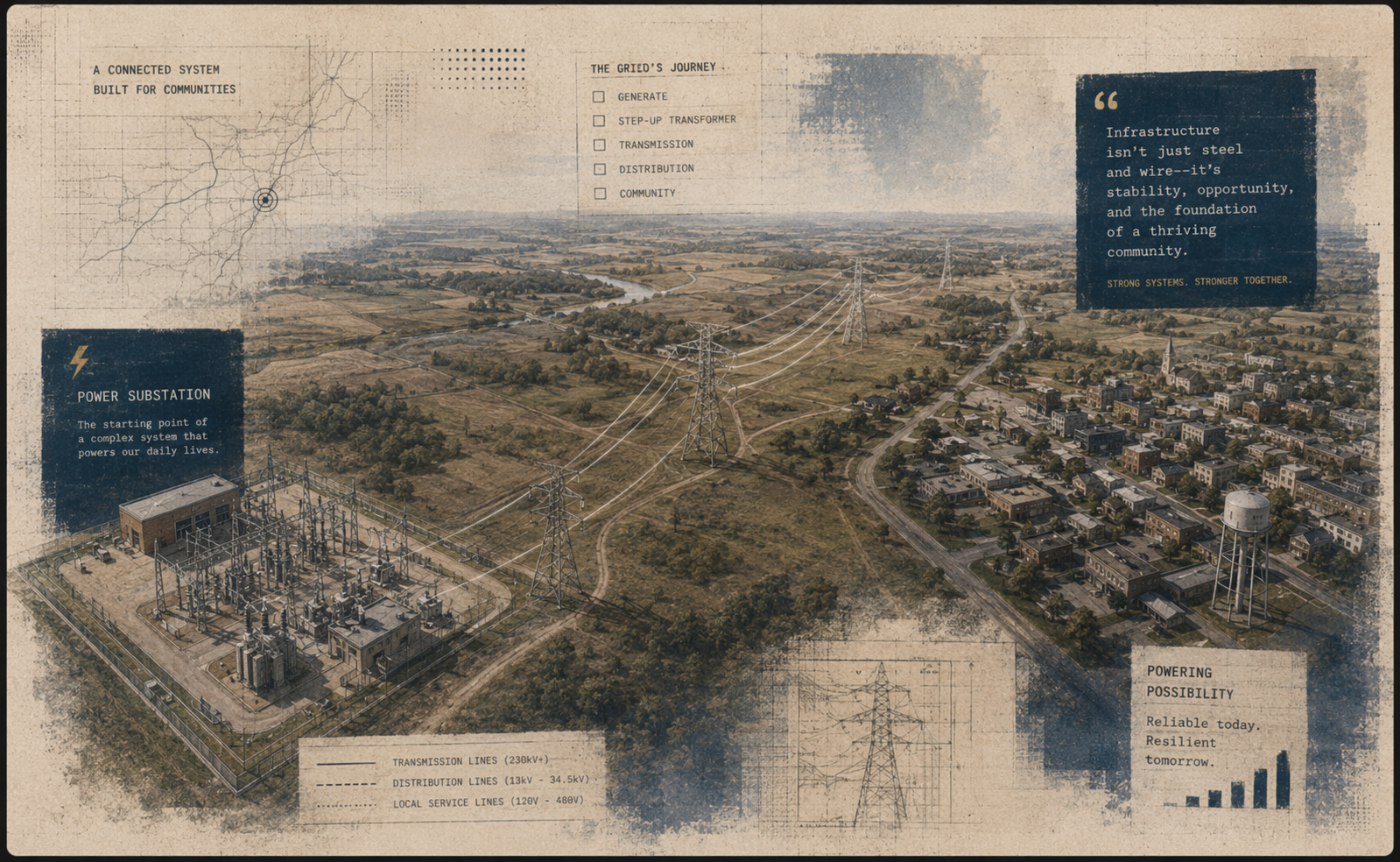
The reality is that creating a municipal utility isn’t as simple as taking over billing and dispatching a few line crews after a storm. A community would need to acquire substations, poles, transformers, distribution lines, easements, meters and countless other assets. It would then need to build an organization capable of operating and maintaining that system every day. That means engineers, dispatchers, customer service representatives, cybersecurity specialists in the modern era, billing staff, emergency response personnel and everyone else required to run a modern utility.
The cost is staggering.
Even relatively small service territories could require tens of millions of dollars in acquisition costs. Larger communities could face hundreds of millions. That’s before factoring in litigation, startup expenses, working capital, deferred maintenance and future infrastructure upgrades.
If any community in the Finger Lakes could realistically attempt such a transition, Ontario County would probably be near the top of the list. It has one of the region’s strongest tax bases, some of the fastest-growing communities in Upstate New York, a diverse economy and a population large enough to support major infrastructure investments.
And yet even Ontario County would struggle to justify taking on the financial, operational and political burden of acquiring and operating an electric utility on its own.
That’s because the challenge isn’t simply buying the system. It’s sustaining it.
Most communities across Upstate New York are dealing with stagnant population growth or outright decline. Infrastructure costs continue to rise while customer counts remain flat. Utilities require enormous economies of scale. The larger the service territory, the easier it becomes to spread the cost of workers, equipment, maintenance and capital improvements across ratepayers.
A town with 5,000 residents or even a county with 100,000 residents simply doesn’t have the same advantages as a utility serving a million or more customers across an entire region.
Which brings us to a proposal that absolutely deserves a good, hard look.
Legislation creating a Hudson Valley Power Authority would establish a regional public power entity capable of acquiring and operating an existing investor-owned utility across an entire service territory. It hasn’t moved out of committee. But, rather than asking individual municipalities to buy pieces of the grid and run them independently, the authority would be empowered to acquire utility assets, operate electric service, issue bonds and manage the system as a public benefit corporation.
Whether you agree with the legislation or not, it recognizes a fundamental reality here: Eectric systems are regional.
Transmission networks don’t stop at town lines. Storm restoration doesn’t stop at county lines. Workforce recruitment, power purchasing, infrastructure planning and grid modernization all happen on a regional scale.
The electric grid already functions that way. The governance model arguably should too.
But there’s another obstacle that rarely gets discussed honestly among public power supporters.
Trust.
For every person who argues local governments should run electric service, there are several others who complain about the services municipalities already provide. Anyone who has spent time at a town board, village board or county legislature meeting knows this dynamic well. Residents routinely criticize road maintenance, water systems, code enforcement, planning decisions and local spending. Asking those same communities to suddenly operate one of the most complex pieces of infrastructure in modern society is a tough sell.
A regional authority doesn’t eliminate those concerns, but it does create some distance between day-to-day utility operations and local politics. It allows communities to share costs, pool expertise and establish governance structures focused specifically on energy rather than asking town supervisors, mayors and village trustees to become utility executives overnight.
The strongest argument for a regional public power authority isn’t ideological.
It’s practical.
Supporters point to lower borrowing costs, public ownership and the absence of shareholder profit motives. Critics raise legitimate concerns about governance, accountability and the role of government in essential services. Those debates will continue.
But before we jump to the conclusion that every town should simply start its own utility, it’s worth recognizing the sheer scale of what we’re talking about.
The electric grid is one of the most capital-intensive and technically complicated systems our society operates. Running it successfully requires expertise, financing and organizational capacity that most local governments simply don’t possess.
So, the question isn’t whether public power is possible.
The question is whether it makes more sense for dozens of communities to try doing it separately, or for an entire region to work together. Like so many of the problems communities across Upstate New York face — a unified voice and approach to problem-solving is going to be paramount.
No matter what the issue or solution on the table.