Recent coverage of Upstate New York’s energy crisis should sound alarms across the board. In Ontario County, local leaders called the state’s electric grid a “recipe for disaster,” warning that infrastructure simply isn’t keeping pace with new development and population growth. Meanwhile, RG&E rolled out plans to fund grid expansion through higher customer bills — a reminder that in our current model, the public always pays while private utilities keep control and profits.
That same imbalance runs through the New York Independent System Operator’s new Comprehensive Reliability Plan. It confirms what those headlines only hint at: The private-sector model that runs our electric grid is broken.
The old bones of a privatized system
A quarter of New York’s power plants are over 50 years old. Seven percent are older than 70. If we’re going to talk about things that qualify as a “recipe for disaster” that’s definitely one.
If 25% of your infrastructure were half a century old and failing more often each year, you’d rebuild it. But under deregulation, maintenance and replacement depend on profit, not public need.
The NYISO projects roughly 3,000 megawatts of fossil-fueled capacity will disappear by 2034, too. That’s not a minor deficit. It’s a looming capacity cliff.
Privatization didn’t work
The idea behind privatization was simple: Competition would bring innovation and efficiency. But the state’s own data now show how hollow that promise was.
NYISO admits that “persistent development challenges” — permitting delays, financing problems, and policy uncertainty — are stalling new energy projects. Over 10,000 megawatts of new demand from data centers, industrial facilities, and electrification are in the queue, but the supply side isn’t keeping up.
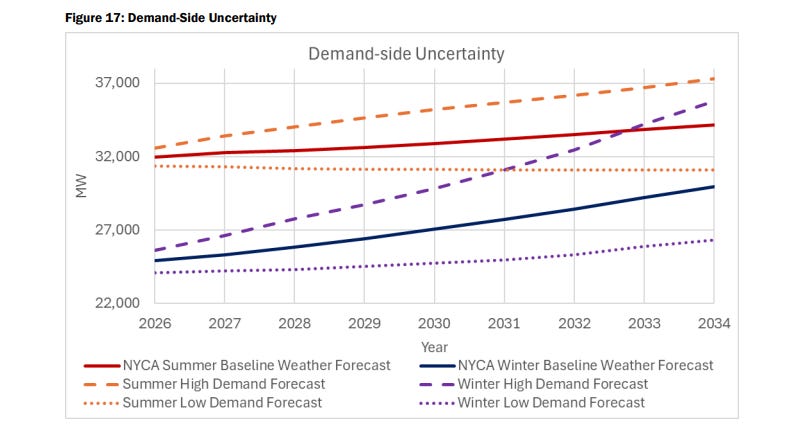
These new loads can appear overnight. The infrastructure to serve them takes years. That gap between speed of demand and pace of investment is the cost of running public systems through private hands.
And here’s the thing: You can talk to people who have worked for these utilities before- and after- privatization. They’ll tell you the product was better before the transition occurred.
Because service was prioritized over profit.
We’re getting too close to an emergency
The June 2025 heatwave was a case study in failure. Imports from neighboring states dropped by 2,000 megawatts when those states prioritized their own needs. New York was left short, forced into emergency operations. We didn’t see a ton of headlines about it because New York got by — barely.
Privatization fragments responsibility. Each operator acted “rationally” for its market — and collectively, the system almost failed. It’s clear, and unlikely, that we make it through another summer like this one without major issues.
Reliability shouldn’t depend on profit margins
NYISO’s own conclusion is damning. The state’s reliability planning has become reactive, dependent on emergency measures. The organization now says it needs “policy alignment” — bureaucratic language for government intervention.
That’s what happens when the market fails: The state has to clean up after it.
Reclaiming the grid won’t be easy
This isn’t about nostalgia for state-run utilities. It’s about accountability. Public utilities answer to voters. Private ones answer to shareholders.
Public ownership allows planning ahead of profit, because the mandate is reliability — not quarterly returns. Yet right now, our grid is managed by an operator that openly concedes it cannot guarantee long-term adequacy. Private developers are chasing profitable projects and delaying the rest.
We wouldn’t tolerate that kind of instability from a water system, a police department, or a hospital. We shouldn’t tolerate it from the grid either.
Electricity isn’t a luxury. It’s a public good. And the longer we pretend otherwise, the more we’ll pay for a system that puts revenue before reliability.
If New York wants a resilient and affordable energy future, it’s time to take the grid back and put the public back in public power. Especially since the bills are about to increase again for worse service.