
Build more. Don’t build here. Protect this. Change that. Loosen regulations. Tighten standards. Rinse and repeat.
And yet, nothing really changes. Prices stay high. Supply stays tight. And every proposal turns into a fight over the same ground — density, traffic, character, environment.
Then the simpler question gets lost in all that: What are we actually building?
Because right now, most communities are stuck choosing between two options — a single-family house or a large apartment building. There’s not much in between. And that’s part of the problem.
A few weeks ago, I wrote about how the system we’ve built makes “affordable housing” incredibly expensive to produce. In some cases, more than $500,000 per unit. That’s not a sustainable solution. It’s a workaround. It’s what happens when you try to force affordability into a system that doesn’t naturally produce it.
So the obvious follow-up is: What else is out there?
Two ideas that don’t get nearly enough attention are cottage courts and social housing. Both came to me from recommendations of other Substackers. They’re very different, but both point to something the current system is missing.
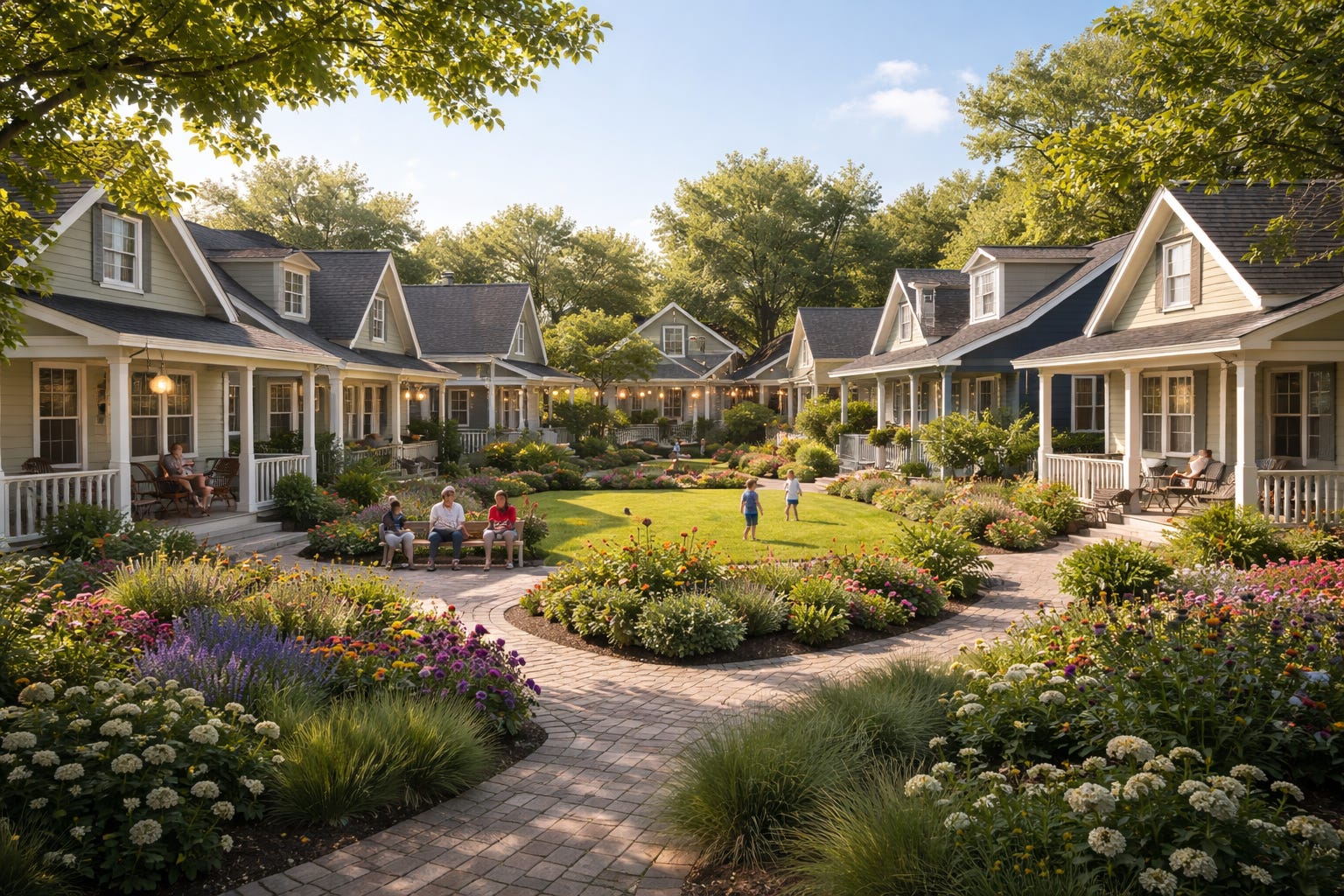
Start with cottage courts. The concept is simple. Instead of one house on a lot, or a large apartment building, you have a cluster of smaller homes arranged around a shared courtyard. Six, eight, maybe a dozen homes — each smaller than a typical single-family house — grouped together in a way that still feels like a neighborhood. Not an apartment complex. Not a subdivision. Something in between.
Something that can even be accommodated by express zoning standards.
The middle ground matters more than we tend to admit, though. Most communities say they want more housing, but not too much housing. They want something that fits. Something that doesn’t overwhelm a street or fundamentally change how a place feels. Cottage courts are one of the few models that actually thread that needle. They add real density — often two or three times what a typical single-family lot would allow — without requiring a four-story building or a massive footprint.
They also avoid some of the cost drivers that make larger projects so expensive. The bigger the building, the more requirements you trigger — elevators, fire suppression systems, structured parking, more complex engineering, more complicated financing. Costs stack quickly. Cottage courts don’t eliminate that, but they sidestep enough of it to make smaller-scale development more feasible, especially for local, non-corporate builders.
So why don’t we see more of them?
Because in most places they’re functionally illegal. Minimum lot sizes, setback requirements, parking rules, frontage standards — layer enough of those together, and a project like this just doesn’t pencil out. Even if everyone agrees it would fit the neighborhood.
So we default back to the same two options. Big, or nothing.
Social housing takes the conversation in a completely different direction. It’s not about what the building looks like. It’s about who owns it.
Right now, almost all housing in the U.S. follows the same basic model. A private developer builds it, a private entity owns it, and the rents or sale prices are driven by the market. Affordable housing tries to soften that with subsidies. That’s how we end up with projects that cost hundreds of thousands of dollars per unit to deliver, even when they’re labeled “affordable.”
Social housing flips that model. Instead of relying on the market and trying to patch over the gaps, the public — or a public-backed entity — owns the housing outright and operates it long-term. Rents are tied more closely to cost, not just demand, and the goal isn’t to maximize return. It’s to keep housing stable and accessible across a range of incomes.
That might sound abstract, but it’s already being tested. Seattle is in the early stages of building a publicly backed housing developer funded by a dedicated tax, with the goal of creating permanently affordable, mixed-income housing outside the traditional market. It’s an experiment, but it’s a serious one. And obviously, the thought of another tax would make most New Yorkers disengage. But living in one of the highest taxed states in the country — we should ask — do the resources to complete this task already exist?
Cottage courts are the easier lift. They don’t require a new tax or a new agency. They require local governments to change the rules and allow something different to be built. That’s still a fight, but it’s a familiar one. It’s about zoning, approvals, and whether communities are willing to accept a different kind of housing on a small scale.
Social housing is harder. It requires money, structure, and long-term commitment. It requires treating housing less like a commodity and more like infrastructure. But that’s an interesting line of logic that an increasing number of economic development folsk are taking seriously.
The bottom line is that our existing system isn’t working very well.
When it costs half a million dollars to produce a single “affordable” unit — it’s a signal. And when the only realistic options are large apartment buildings that trigger backlash, or single-family development that prices out most residents — that’s not flexibility. It’s more strain.
There’s a tendency in housing debates to focus on whether something should be built. We spend far less time asking what should be built, and who should own it.
That’s where these two ideas come in. Cottage courts offer a way to add housing without forcing communities into an all-or-nothing choice. Social housing offers a way to step outside a system that increasingly requires massive subsidy just to function.
Neither one is a silver bullet. But they’re different. And doing something different sounds a lot better than continuing down the road we’ve been on for over two decades.
Thanks for reading In Focus! Subscribe for free to receive new posts and support my work.