
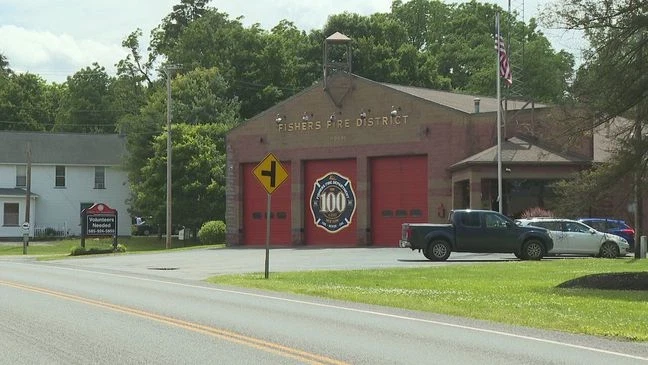
If you call the Finger Lakes region home or have visited in recent weeks you’ve probably heard of the Fishers Fire District. The surface-level question right now boils down to this: Will Fishers continue operating or will its service area, which is the western portion of Victor, be rolled into the Victor Fire Department’s area?
Before proceeding, it’s important to note that Victor and Farmington represent two of the fastest growing communities in Upstate New York. Not just recently, but for many, many years. That’s an important detail because detractors of the Fishers Fire District say costs have ballooned too much in recent years.
To put it plainly: Trust has been eroded between the public and the Fishers Fire District Board of Commissioners. A group of frustrated taxpayers had—a few years ago—attempted dissolving the fire district, as well as it’s service. That effort failed, and the group went and got new fire commissioners elected who share their view. Commissioners are the governing body for a fire department or district. They vote on matters and hold meetings the same way a town board does.
This time when the fire commissioners proposed dissolving Fishers the community reacted with a lot of concern. People who live in the Fishers Fire District pay a special tax to pay for the service. This tax is in addition to the taxes paid to the Town of Victor.
The crux of the debate is pretty straightforward: Proponents of dissolving Fishers say the cost is too great and keeping the district financially solvent isn’t possible. Opponents of dissolution say no effort was made to fix the financials and this will just weaken emergency response.
In late-August, Fishers Fire Commissioners will vote on whether to move forward with dissolution or not. If they do, call it a done deal, and the Town of Victor will have to pick up the pieces. If they do not, it will probably just delay the inevitability that some folks want to see Fishers shuttered.
That aside, there are a couple of things writing this newsletter (and previous columns over the last decade-and-a-half) that ring true:
Eliminating a service doesn’t eliminate demand; and
Costs to provide service will balloon if it becomes more challenging to meet that demand.
What do I mean?
According to officials, Fishers responded to 1,300+ calls in 2024. Those calls won’t go away with dissolution—and they’ll have to be handled by other agencies paid for by Town of Victor taxes. These costs might not be represented in your current tax bill, but will be accounted for in future Town budgets and tax bills.
And this aligns with virtually every dissolution I’ve watched play out up-close. Typically, they’re villages. But the same principles apply. A Village can choose to stop providing garbage collection or other services that drive up annual budgets. But when they do not, costs are just shuffled around, and the bill comes from a new place.
The second item is a little trickier to predict, which should be the cautionary portion of this tale. It becomes very difficult to predict total cost if the cost to respond to 1,300+ calls changes because of proximity, shared services (and those providers’ costs), etc. Those are just the municipal costs, too. What happens to the price of homeowners insurance when fire response time is slower?
They increase!
Factors like proximity to nearest fire station and career vs. volunteer staffing play a major role in determining the price of homeowners insurance. There’s also this thing called Public Protection Classification, which is a scoring system insurance providers use to determine how risky a property is to insure. The same can be said for commercial property owners. And if you’re looking for estimations—it’s anyones guess. Some say 20-50% increases are possible. While others say it could cost $100 to $500 more per year.
It all boils down to this: You might think you’re paying less after dissolving a fire district. And maybe a line item or two are eliminated. But, the likelihood that you make up or surpass those savings in new expenses is high. And when it comes to an essential service like fire protection—is it worth the loss of trust and headache that comes from dissolving?