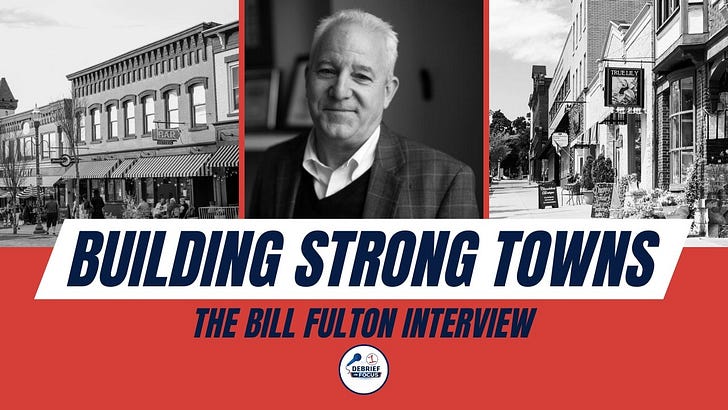
Today’s column features a conversation with Bill Fulton, a veteran urban planner, author, and former mayor of Ventura, California. Over the course of his career, Fulton has served as a city planning director, led major urban research efforts at Rice University’s Kinder Institute for Urban Research, and advised communities across the country on land use and economic development. He’s written extensively about the intersection of growth, politics, and prosperity, including in his book Place and Prosperity. He now publishes regularly on planning, housing, and the changing role of place through his Substack newsletter The Future of Where.
We need all kinds of growth
Communities don’t usually decline all at once. They drift there — slowly, politely, and often while insisting they want the exact opposite outcome. That’s been a theme of this column and newsletter since it’s relaunch.
And that was the thread running through my recent conversation with urban planner and former Ventura, California mayor Bill Fulton. He’s an Auburn native, who’s written plenty of books and even started his career as a reporter for The Auburn Citizen.
Fulton says on paper, almost every town says the same things: They want businesses back, a lively downtown, younger families, and economic stability. In practice though, they tend to resist the one ingredient that produces all of those outcomes — change.
Fulton has spent decades inside city halls, planning departments, and research institutions watching this play out. And his diagnosis is pretty straightforward. The housing debate isn’t really about zoning, density, or even affordability. It’s about communities wanting economic results without accepting the physical evolution required to get them.
“The biggest problem is the availability of all kinds of different housing, at different prices, in desirable locations,” he told me. “Communities in desirable places suppress housing, and communities on the outskirts welcome it even when it’s a bad fiscal deal. That mismatch remains the biggest problem.”
In other words, the places people most want to live make it hardest to live there — and the places that approve growth often weaken themselves by doing so.
Local opposition to development is usually framed as protecting character. Residents talk about traffic, property values, neighborhood feel, and community identity. Fulton says those concerns are real, but they’re also misdirected.
“People don’t like change, and their sense of community manifests in a physical way,” he explained. “But if you don’t change the physical character of your community, the demographic character of your community is going to change.”
That’s the paradox playing out across Upstate New York and countless similar regions. Towns want families but block housing. They want workers but resist apartments. They want businesses but oppose population growth.
The result isn’t stability. It’s replacement. Prices rise. Younger residents leave. Employers struggle to hire. School districts shrink. And eventually the very character residents were trying to preserve disappears anyway.
Fulton pointed out that even the most common fear — falling property values — often misunderstands basic economics.
“If more housing near your home creates coffee shops and restaurants you can walk to, the value of your house is going to go up,” he said. “People use property values as a proxy for discomfort.”
What communities are often protecting isn’t value. It’s familiarity.
Part of the confusion comes from the fact that the old concept of “build it and they will come.” For decades, development followed jobs. Commuting determined housing. Planning assumed predictability. That world fractured after COVID.
“The number of people working at home full time went from 5% to 15% — it tripled,” Fulton said. “But that’s still not most people. So now communities are going in both directions.”
Some places are building around amenities — walkability, town centers, quality of life. Others are seeing longer-distance commuting as people move farther out to afford housing. Instead of a single growth pattern, there are multiple competing patterns.
And yet, one demand signal is unmistakable.
“There is a market for high-amenity communities,” Fulton said. “More walkability, more access to town centers. People want it, but we build very little of it.”
Across New York, zoning reform has become the centerpiece of the housing conversation. Allow duplexes. Allow accessory dwelling units (ADUs). Allow smaller lots. The assumption is that once regulations loosen, the problem solves itself.
Fulton warns that expectation is incomplete, though.
“Zoning reform is necessary but not sufficient,” he said. “The market has to respond, and government and nonprofits often have to participate. It doesn’t solve everything.”
He pointed to accessory dwelling units — the popular backyard apartment policy — as a perfect example. Helpful, yes. Transformational, no.
“They’re part of the solution. They’re not the only thing that will solve the problem,” Fulton said.
When towns debate development, they typically start by arguing over individual projects — a subdivision, an apartment building, a zoning change. Fulton says they’re starting in the wrong place. Instead, they need to answer a more uncomfortable question: What role are we actually going to play?
“Start by understanding your role in the regional economy,” he explained. “Are you a job center? A suburb? A service hub? You have to be realistic about that.”
Many communities try to be everything at once — bedroom community, tourism destination, employment hub, and preserved village — and end up achieving none of them effectively. Clarity forces tradeoffs. Tradeoffs require change. And that’s where resistance returns.
Because the underlying issue in nearly every housing debate isn’t technical. It’s emotional.
Every community believes it can keep its physical form intact while improving its economic fortunes. Fulton’s experience suggests that’s rarely possible. You don’t get downtown businesses without nearby residents. You don’t get employers without workers. You don’t get affordability without supply. And you don’t get any of those without visible change.
The alternative isn’t preservation. It’s slow erosion. And we’ve watched it play out for several decades across Upstate.
What struck me most about our conversation is that Fulton never framed this as ideology or planning theory. He framed it as math. Communities require a mix of incomes, ages, and occupations to function. If housing policies prevent that mix, decline becomes predictable — and even inevitable.
The debate happening across the region isn’t really about density or aesthetics. It’s about whether communities are willing to evolve enough to stay alive.
I’ll end this week with another common theme in this column since it’s relaunch: Doing nothing is not neutral. It’s a decision. And for most communities it’s the most-consequential one any have made in the last several decades.
Communities that embrace change shape their future. Communities that resist it still change. They just don’t control how.
Thanks for reading In Focus! New columns are released weekly. Drop you email below if you’d like to receive more!